



Recent Posts

  • Reaction to S&P putting UK sovereign debt on negative outlook

    Topics
    AAA rated, GDP

    Posted May 21st, 2009

    This morning S&P announced that the outlook on UK’s long term sovereign credit rating was put on negative outlook.  It’s important to stress that a change in rating outlook does not mean that a downgrade to AA is inevitable, but obviously the risk has increased (S&P say the chance is “one in three”). The primary reason for the change was that the “UK’s net general government debt may approach 100% of GDP and remain near that level in the medium term”.  10 year gilt yields initially spiked 13 basis points on the news, but have since recovered most of the lost ground.

    In truth it’s a bit of a surprise that people were surprised.   Firstly, it’s been clear for some time that the UK’s government debt is approaching 100% of GDP.  Indeed the OECD were saying this back in March, as can be seen in the second chart in a recent comment on this blog (see here).

    UK has traded like an AA rated issuer for some timeSecondly, as we wrote in October last year and more recently this February, the credit derivatives market has long been saying that the risk of default on the UK is broadly in line with an AA rated sovereign rather than an AAA rated one.  This chart (data as at the end of yesterday) shows the 5 year CDS on a range of European sovereigns, and as you can see the premium for insuring against the risk of default on Germany and France (both rated AAA) has been considerably lower than the premium for the UK for quite a while.  Since the end of last year, the implied risk of default on the UK has been more in line with AA rated issuers such as Belgium, Portugal and Spain.  (Note that if the credit derivative market is anything to go by, Switzerland and particularly Austria may soon find their AAA rating under threat too).

    So does it matter if the UK does eventually get downgraded to AA?  Judging by this morning’s very successful UK government bond issue, not much.  The UK’s Debt Management Office issued £5bn of UK gilts maturing in 2014, and the issue attracted bids for 2.6 times the amount offered.  This was impressive considering that, as RBC have pointed out, it was the biggest ever nominal amount of bonds sold in a single operation.  Also, a credit rating downgrade doesn’t necessarily mean government bond yields will rise – Moody’s downgraded Japan to A2 in June 2002, which was lower than the credit rating of Botswana at the time, and that didn’t stop 10 year Japanese government bond yields getting to 0.4% in May 2003.  And lastly, what do the credit rating agencies know anyway – as we’ve previously documented on this blog (see here), Moody’s rated Iceland Aaa until May 2008.

  • Are corporate bonds still attractive following the rally?

    Topics
    News

    Posted May 19th, 2009

    In the worst of the Great Depression, US BBB spreads peaked at 724 basis points (see chart).  Then in Q4 last year, extreme risk aversion and a huge number of distressed sellers meant that credit markets collapsed.  On December 16 2008, soon after we last produced the chart on this blog (see here), US BBB spreads peaked at a 76 year record of 804 basis points.

    This year has seen a big bounce in corporate bonds.  A combination of a more positive economic outlook and a tailing off of hedge fund blow-ups has resulted in the pressures on the corporate bond market easing. While US Treasuries returned -3.0% from the beginning of the year to last Friday, US BBB corporate bonds were up an astonishing +10.2%.  European BBB corporates have returned +9.7%, although UK BBBs have lagged with a +1.6% return so far this year, which is due to the UK index having a much larger weighting in subordinated financials at the turn of the year.

    Are credit spreads still attractive?  On the face of it, yes.   If you exclude four months in 1932, US BBB spreads have never been wider prior to this cycle.  But wide credit spreads do not necessarily mean that the asset class is attractive.   Credit spreads definitely deserve to be wide right now, reflecting both the severe recession that we are currently experiencing, and the risk that the recession may last longer or be deeper than the market currently anticipates.

    Another thing to bear in mind is that these charts of nice high credit spreads that investors are probably now familiar with are painting a slightly misleading picture.  This is because of the way in which yields are quoted on subordinated financials.  In the chart above, UK BBB spreads are significantly wider than in the US or Europe, which is a direct consequence of financials being only 12% of the US BBB index and 13% of the European BBB index, but 23% of the UK BBB index. 

    To understand why yields on subordinated financials are overstated and to understand the scale of this problem, take the Barclays 6.3688% 2019 as an example.  This is a sterling denominated Tier 1 Barclays bond, with a total issue size of £500m.  It currently has a price of 57 pence in the pound.  Its yield is quoted as 13.9%, which is assuming that the bond is called in 2019.  This is a shaky assumption.  Barclays may never call the bond, because Tier 1 and Upper Tier 2 bonds do not have official maturity dates – they are perpetual.  If Barclays decides not to call the bond in 2019 – a decision that may make economic sense given that the bond would then turn into a floating rate bond paying 170 basis point above LIBOR – then  the yield on the bond today is actually a far less impressive 8.9%.  Taking prices on Bloomberg, while the yield to call implies a spread of 1030 basis points on the bond, the ‘yield to worst’ (which assumes the bond isn’t called) implies a far less attractive spread of 450 basis points.  

    This chart is therefore a better measure of whether there is still value in corporate bonds.  It focuses on European and UK Industrial BBB spreads, where an ‘industrial’ is anything that is not a financial or a utility.  Industrial spreads are still wider than the peaks seen in 2002, and we do still believe that investment grade corporate bonds are overcompensating investors for the risk of default.  But if BBB credit spreads were to fall to perhaps 200 basis points and we hadn’t seen further signs of improvement in the economy, then our positive view would likely change.

  • QE or not QE? That is the question

    Topics
    News

    Posted May 8th, 2009

    Whether you want to call it quantitative easing, credit easing, printing money or “enhanced credit support” as Jean Claude Trichet prefers, the ECB yesterday took a step in that direction. At the post rate decision press conference, Trichet announced that they had agreed in principle to purchase up to €60bn of euro-denominatedcovered bonds, which is roughly 10% of the public market. He said that they had decided on covered bonds as that market has been particularly badly affected by the “financial turbulence”.  The announcement is good news for banks in Germany, France and Spain as they are the heaviest users of these instruments (a blog with a bit more detail on covered bonds is on its way). Regardless of how you label it, a foray into the credit markets is a clear signal that the opinions of the doves are becoming increasingly influential.

    Trichet also announced a 25bp cut in the key rate to 1% and emphasised that it had not been decided that 1% was their floor. We were told that the current 6 month maturity on the loans offered to banks would be increased to a year and that the European Investment Bank (EIB) would be permitted to participate in the ECB’s re-financing operations from the 8th July. I find this a particularly clever manoeuvre as it potentially transfers the decision of which firms to lend to from the ECB to the EIB, and any criticism that may come with further interventions in debt markets.

    Trichet made clear that all the decisions were made unanimously, a step no doubt designed as a show of unity after the recent bickering  which came to a head with him asking members not to comment publicly on non-standard measures (see previous blog). Even though the argument appears to be swinging a little in favour of the doves it is clear the hawks are still strongly defending their corner. The weak first quarter economic data may have led one to think that more substantial policy may have been announced, I’m sure if the economy continues to weaken we will be seeing the doves in the ascendance and the hawks marginalised.


  • New issuance hits record levels

    Topics
    News

    Posted April 30th, 2009

    We commented in November that growing levels of new issuance suggested that there were cracks in the ice in credit markets.  This trend has rapidly accelerated.  In the first quarter of this year, there was over €115bn of new issuance from corporates, almost twice as big as the previous record from 2001 and only slightly less than the €133bn figure for the whole of 2008. 

    Why has there been so much issuance?  Part of the reason is that there was a backlog of refinancing that needed to be done in September and October 2008.  But a bigger reason for the surge in issuance is that banks are not able or willing to lend, and if corporates are not able to raise finance (or refinance) with banks then they have to seek alternatives.  And the only alternatives are issuing bonds to (ie borrowing from) people like us, or by tapping the equity markets via rights issues.

    Just as an increase in government bond issuance doesn’t necessarily mean falling government bond prices (see previous blog here), surging corporate bond issuance doesn’t mean falling corporate bond prices.  Taking Merrill Lynch indices, euro denominated investment grade industrials returned +4.1 in Q1%, 3.4% ahead of German government bond returns. Sterling industrials returned +4.2% in Q1,which was 5% higher than the return from gilts. 

    This chart shows how spreads in industrials (i.e. anything that’s not a financial or utility) have tightened over the past three months – euro industrials spreads are at least 100bps tighter than the wides hit in mid December, while sterling spreads are about 70bps tighter. (Note that at the end of May 2007, Euro industrial spreads were just 50bps over government bonds, and sterling 80bps). Spreads remain very attractive in a historical context, and spreads on new issues also continue to be attractive versus spreads in the secondary market.  

    We expect this flood of supply to continue through this year as companies refinance and banks continue to curb lending.  However, we do expect it to fall back later this year and next year. Debt buybacks are already happening, where some companies have been patching up their balance sheets by issuing equity to buy back debt, and we expect this to increase. Many companies simply don’t have efficient capital structures for today’s markets, now that the cost of borrowing is so much higher than it was. Debt buybacks are good news for bond holders, but not necessarily good for equity holders. As companies buy back debt and new issuance falls, credit spreads should tighten fairly rapidly.

  • Horrific European economic data released

    Topics
    News

    Posted April 24th, 2009

    Spain is already in deflation, and this morning it released some horrible unemployment numbers.  Spanish unemployment soared to 17.4% in Q1, from 13.9% in Q4.  This is the first time unemployment has risen above 17% since 1998, and is further evidence of the alarming deterioration in the European economy. 

    Also this morning it was announced that UK GDP was -1.9% in Q1, taking the year on year rate to -4.1% (equalling the annual rate recorded in Q4 1980, which was itself the worst year on year fall since records began in 1956). 

    Then Bundesbank president Max Weber this afternoon said that the German economy may have contracted at least 3% in Q1 alone, which would be the worst quarter since records began in 1970.  The German unemployment rate is likely to exceed 10% later this year, and the Eurozone unemployment rate is already 8.5%.

    Spanish unemployment worse than many emerging markets The chart puts the Spanish unemployment data into an international context.  Unemployment measures do vary across countries, but the Spanish unemployment rate is considerably higher than any developed country, and is worse than a large number of developing countries (although note that emerging market data is a little old).  The higher the unemployment rate rises, the greater the national discontent and the more likely there will be a severe political crisis (and the more pressure there will be for some European countries to leave the euro). 

    UK prime minister Gordon Brown must be jealous that his Spanish counterpart José Luis Rodríguez Zapatero had his election in March 2008, before the global economy began to really fall apart.

  • What effect will the surge of government bond issuance have on government bond returns?

    Topics
    CPI, GDP, inflation

    Posted April 23rd, 2009

    This is a question that numerous clients and members of the press have asked us so I thought it would be worth writing a brief comment here. 

    Focusing on the UK, in yesterday’s budget, chancellor Alistair Darling said that gross gilt issuance will be £220bn this financial year, which is easily a record. There is much speculation as to whether the market is able to digest this much issuance.  If there is a lack of demand, or ‘indigestion’, then prices will have to fall and yields to rise until appetite for gilts returns.  

    The chart shows the relationship between gross gilt issuance in each fiscal year since 1991 against the total return from gilts in that period.  There is no relationship.  It’s also a similar story if you measure gilt issuance as a percentage of GDP, or look at net gilt issuance rather than gross gilt issuance.

    A lack of correlation is not to say that it doesn’t matter if the supply of government bonds is huge – clearly it does matter.  The law of economics says that if the supply of something increases, then all else being equal, the price will fall. But with regards to government bond issuance, all else does not remain equal.  When governments issue lots of bonds, it generally means that the economy is in trouble.  And if the economy is in trouble, it means that spare capacity is probably being created because unemployment is going up and wages are stagnant (or perhaps even falling).  These things all put downward pressure on inflation.  If inflation falls and interest rates are low or falling, then locking into a high fixed interest rate (at least ‘high’ relative to cash interest rates) is very attractive, and demand for government bonds increases. Yields therefore fall and prices rise.  This is exactly what happened last year in the UK – 2008 was the biggest year for gilt issuance but was still a very good year for gilt returns.

    What will cause demand for gilts to rise over the next year to equal or exceed the supply of gilts?  It depends on what happens to inflation and economic growth.  In terms of inflation, Alistair Darling  projects CPI to fall to 1% this year, and RPI to fall to -3% in September before rising to zero next year.  In terms of growth, he expects -3.5% for 2009, +1.25% for 2010 and 3.5% for 2011. 

    Slightly ironically, gilt investors should be hoping that the chancellor has overestimated his growth forecasts, even though this will inevitably result in the budget’s numbers not adding up and even more gilts being issued than projected.  Gilt investors should hope Alistair Darling is wrong because if the chancellor is correct about +3.5% growth in 2011, the economy will be booming at its strongest pace since 1999 and you can be pretty confident that government bond yields will be quite a bit higher. 

    Much can happen between now and 2011, and his growth projection is certainly possible, but at the moment our view is that it is unlikely that UK growth will be this strong.  If UK economic growth does indeed fall short of his projections, then it’s also likely that inflation will fall short too.  And if your core scenario is that sterling won’t collapse (which would put upwards pressure on inflation), then gilt yields are very capable of going lower.

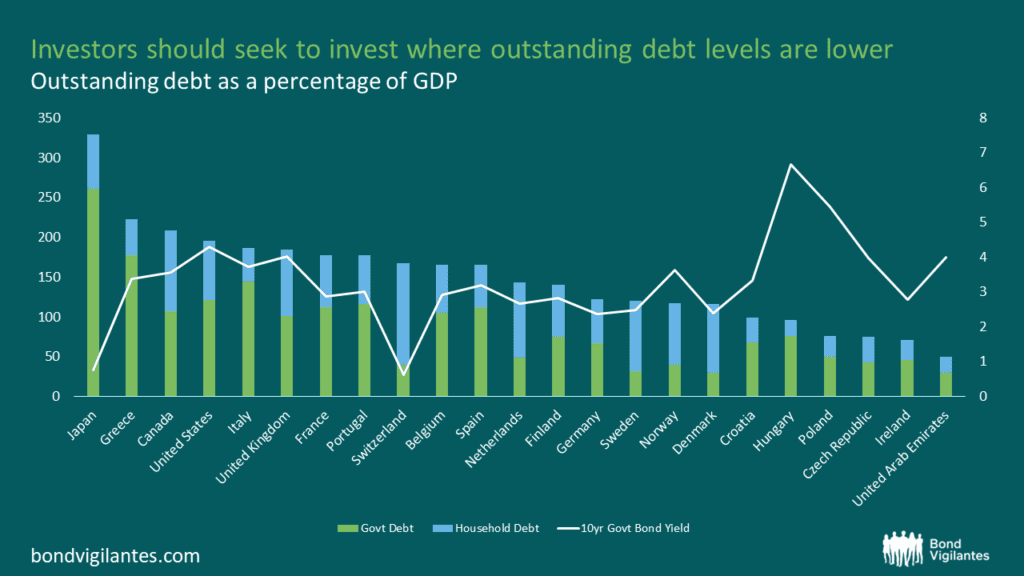
    Finally, as we’ve mentioned previously on this blog, don’t forget what happened to Japan.  There are of course many differences between the UK and Japanese economies, but an important lesson is that large issuance doesn’t mean government bond yields must rise.  The OECD expects Japan’s ratio of public debt to GDP to rise to 197% next year, more than two times as much as for France, Germany and the UK (see chart).  Japanese government debt has tripled since 1996.  And yet today, 10 year Japanese government bonds yield 1.4%, and got as low as 0.4% in 2003.

  • Monetary Forbearance, and the threat of a double dip financial crisis

    Topics
    News

    Posted April 17th, 2009

    With first quarter results out of Wells Fargo, JP Morgan and Citigroup this week in the US, and Barclays over here, you might be forgiven for starting to think that the financial crisis is well along the bumpy transition to the next phase, ie a global ‘real economy’ crisis. To some extent, I think we’d have to agree. We have come a long way from the week that Lehman went, when it felt like AIG would go the very next day. But we also firmly believe that the transition will not be smooth. And I would also like to point out a substantial risk that current measures are likely to meet further down the road.

    Regulatory forbearance is a term that gained currency during the savings and loan crisis in the US of the 1980s and early 1990s, and a variant of it was also used during the Japanese banking crisis. It is essentially the relaxation of accounting rules and regulations applied to banks in regards to recognition of losses on bad assets. The idea is that relaxation enables banks to delay recognising losses, which in turn provides the banks with the time and flexibility to return to profitability.  This enables banks to start increasing internally generated capital through retained earnings, which enables them to better cope with the latent losses they have on their balance sheets. The recent relaxation of fair value accounting methods by FASB in the US is a form of just this policy.

    But this time round, I think we can coin a new phrase for the forbearance of bad assets: monetary forbearance. Interest rates across the western world are at historically low levels, and our view is that rates are likely to stay at or near zero for quite some time yet, given our deflationary outlook. Financial crises simply are hugely deflationary. The direct consequence of this is that yield curves are steep, particularly in economies where quantitative easing programs  are underway, because the market’s expectation is that yields will eventually rise when the bonds are sold back to the market, and because QE should, all else equal, be inflationary. Banks borrow short term and lend long term, so with policy rates being so low and yield curves reasonably steep, they are able to post very decent profits. Wells Fargo’s results best demonstrated just this fact.

    Another advantage banks gain from low rates is that loan defaults are minimised for those borrowers who have variable rate debts. So the banks get a double-whammy: an excellent net interest income portion of their income statements from low rates and the yield curve, as well as the added benefit of borrowers finding it easier to pay. That is monetary forbearance, here defined. Banks are getting the opportunity to start to earn their way out of the crisis, and low rates mean fewer loans are going bad.

    But rates will not stay low forever. Indeed, for investors who believe that QE will be very inflationary, then rates will have to rise, and rise aggressively to control price increases. In the US, where the majority of the mortgage market is on fixed rates, this inflation will be a welcome development, since inflation dramatically increases the affordability of long-term fixed rate obligations. But in the UK most of our borrowings are floating or variable. When inflation returns we can expect the MPC to hike rates aggressively if needed, and this could well spell doom for UK borrowers, whose cost of borrowing will rise along with interest rates. At this point, monetary forbearance will be a warm but distant memory for UK banks, because higher rates will be directly correlated with a rise in defaults on banks’ assets. And this could be a quite brutal period for the economy and the financial institutions. Perhaps, even, a double dip in the financial crisis?

    Unfortunately, it seems unlikely that this kind of outcome only comes in the event of severe inflation, and the resulting aggressive tightening of monetary policy. Disposable income is plummeting right now as jobs are being lost and bonuses are shrinking or disappearing. Enforced pay-cuts are likely to spread. Furthermore, an enormous part of the mortgage market was financed during the heady days of 2003 to 2007, which means the average size of existing loans is too large, as property was severely overvalued. This means that all the people who borrowed in this period are particularly sensitive to the size of their interest payments, and therefore particularly sensitive to rising interest rates. So, small rises in rates, along with fewer employed people and less disposable income, could have dramatic effects on people’s ability to pay their debts. This is bad for the consumer, and bad for banks.

    How can we avoid this outcome, now we are engaged in QE? Well, if you want to assume an inflationary outcome to all this, the best way would be to move quickly towards the US mortgage market model of fixed interest rates. I don’t see this happening any time soon. The availability of credit at affordable terms has gone: where you could once get a mortgage for more than 100% of the value of the property,you now need around a minimum deposit of about 25%.  But huge swathes of homeowners are now in negative equity, so these people are unlikely to have that kind of deposit available to them. If you instead assume that inflation is harder to regenerate, even with QE, then this solution would be a nightmare scenario because fixed rate obligations in deflation become more and more expensive to the borrower.

    The outcome to all of this is so unclear as to make this mere conjecture. But it seems that, on all the cases considered above, the outcome is likely to be unpleasant for borrowers and for banks.  And it is hard to see how banks’ large reported ‘accounting’ profits can be continued over the medium term.

  • US in deflation for first time since 1955

    Topics
    News

    Posted April 16th, 2009

    Some interesting numbers came out of the US yesterday.  US CPI was -0.1% in March, below expectations of +0.1%.  This means that US CPI was -0.4% versus a year earlier, the first time there’s been a negative reading in over 50 years (see chart). 

    (It’s important to stress that I’m quoting the broad measure of CPI, which is including food and energy costs – the Federal Reserve, unlike the ECB and Bank of England, prefers to strip out the effects of food and energy from its inflation numbers.  ‘Core CPI’ was +1.8% in the year to March.  See an old blog from Richard here on whether central banks are targeting the correct inflation measures).

    To understand why CPI has turned negative, and to understand why we think it’s likely that a number of other countries will experience deflation in the next few months, you need look no further than the ‘capacity utilisation rate’ for US, which was also released yesterday.  A capacity utilisation rate of 69.3% for the end of March is the lowest figure recorded since the data series began in 1967 (see chart).   See here for a comment that Jim  wrote on relationship between the output gap and inflation.

    So we now have US CPI negative on a year on year basis.  In the UK, RPI is now zero year on year and likely to turn negative soon (although CPI is still at +3.2%).   Spain, Portugal, Ireland, Switzerland, Japan, Thailand and Taiwan are already in deflation, while German and French inflation is only slightly above zero (the inflation rate for the Eurozone as a whole to the end of March was +1.2%).  

    The thing that all investors are trying to figure out is whether deflation proves temporary and relatively painless, or whether it develops into a deflationary debt spiral of death whereby investors delay making purchases as they can buy the same goods at a cheaper price in the future.  Such behaviour would serve to exacerbate this already severe economic downturn. 


  • ECB – let’s get ready to rumble!

    Topics
    News

    Posted April 16th, 2009

    It’s all getting rather interesting at the ECB. Facing a rapidly deteriorating economy and the prospect of deflation, the governing council are at odds on the best way to deal with the crisis.

    Fighting out of the blue corner, the German duo of Axel Webber and Jurgen Stark argue that cutting rates further and/or embarking on quantitative easing (QE) in a US/UK style would have little positive impact. Yesterday, Webber said in a speech that he would be critical of lowering the key rate to below 1% and that “direct interventions in the capital markets should take a backseat”. Stark’s philosophy is more hawkish; in a speech he gave last month, he effectively ruled out involvement in the capital markets by stating “the health of the financial system cannot be made the ECB’s responsibility” (he didn’t offer any suggestions as to whose responsibility it is, but one assumes he is looking to individual governments). He also feels that cutting rates further could exacerbate the problem by weakening “the incentives for banks to clean up their balance sheets…and monitor their credit risk carefully”. The solution coming from these two seems to be to keep calm and carry on.  They suggest continuing with the policy of offering banks unlimited loans, and Webber has also suggested lengthening the loans from the current six months to a year.

    And in the Red corner, representing Greece, Cyprus, Italy and Austria we have Provopoulos, Orphanides, Smaghi and Nowotny. Provopoulos has indicated that he may support a rate lower than 1% if necessary, and would also be in favour of involvement in the capital markets. Orphanides went further in January, saying it is “dangerous” to take the view that monetary policy becomes ineffective as rates approach zero. Smaghi is a little less dovish, favouring an interest rate of zero if it’s justified, but would prefer the ECB committing to maintain a low rate of interest for a “prolonged period of time”. Nowotny agrees with the Germans to an extent as he thinks lengthening the maturities of the bank loans is the fastest option but has also recently said that “the purchase of commercial paper, corporate bonds and similar things” would be “sensible”.

    The referee for the fight will be Jean-Claude Trichet.  He has been non-committal as ever on “non standard measures”, although he did signal that the rate is likely to be cut to 1% at next week’s ECB meeting. None of the QE advocates have yet described how the process of purchasing government bonds (let alone corporate bonds) would work. This will be a major hurdle to intervening in capital markets, as the process will inevitably become extremely politicised. Hopefully next week both parties will  add more colour to their arguments. I for one would like to have a ringside seat.

    If you’re interested in watching how the fight unfolds, you can read ECB speeches as they occur here.

  • George Osborne, UK Shadow Chancellor, to change inflation target?

    Topics
    News

    Posted April 8th, 2009

    In a speech this morning, the Shadow Chancellor George Osborne hinted that he might change the UK’s inflation target if the Tories form the next Government (and it’s difficult to see how they can muck it up from here).  Currently the Bank of England must set monetary policy to keep CPI inflation within the band 1% to 3%, and must write a letter to the Chancellor in the event of "missing".  With the benefit of a bit of hindsight, commentators are saying how stupid it was not to also target house price inflation (and to be fair to Mervyn King he had publicly criticized the CPI measure on that basis as long ago as 2006), and that by ignoring them, rates were kept too low for too long, and the property bubble resulted.

    It’s hard to predict what a Conservative inflation target would look like, but let’s assume they are elected in May 2010, and that they include some measure of house price inflation (HPI) in their target. Let’s also assume that this house price crash is as long and severe as the last one from mid 1989 to mid 1995 (chart here).  If that were the case, then although we’ve seen the steepest falls in prices, we might not see a rising trend in prices until 2012 or 2013.  On this simple, and highly speculative analysis then, including house prices in the Bank’s inflation target could cause them to keep interest rates lower than under the current regime for the next few years (the electorate won’t complain about that).  We could eventually therefore see higher levels of core inflation for a given level of interest rates.  The bond markets won’t like that.  It is also possible that if housing prices did boom again, that the Bank would have to live with negative core inflation rates (deflation) until house prices stabilised again. The appropriate weighting of asset prices within an inflation target is going to be the topic of a very interesting debate.


Follow us on Twitter

For Investment Professionals only. No other persons should rely on the information contained within this website.

Download or order a hardcopy of the 5th Anniversary Bond Vigilantes book and make a donation to Cancer Research UK

5th Anniversary Bond Vigilantes book

Follow us by RSS

Bond Vigilantes

Bond Vigilantes News Feed

Search Bond Vigilantes

Sign up for exclusive email updates from the Bond Vigilantes

The information we collect from you is used solely for the purpose of notifying you of updates to the www.bondvigilantes.com website.


* = required field

Who we are following on Twitter

Bond Vigilantes Twitter Feed

Recent videos from iView

By clicking on these links you will be visiting iviewtv.com

Next iview