



Recent Posts

  • A review of fixed interest asset class returns in 2011

    Topics
    corporate bonds, gilts

    Posted December 14th, 2011

    The decorations are up, the presents are under the tree, and I’m starting to think of New Year resolutions. Yes 2012 is almost upon us. With that in mind, I thought it might be interesting to have a quick look at who have been the winners and losers in debt markets over the course of an eventful 2011.

    As the below chart shows, investors in UK gilts have had a fantastic year. The top performing area of the bond market has been inflation-linked gilts which have provided a fantastic return of 16% to investors, despite the Bank of England’s quantitative easing programme not targeting this area of the market. Investors have sought the protection of inflation-linked assets in a horrible year for the Bank of England where inflation has hovered around the 5% mark due to higher commodity prices and tax increases. UK and German government bonds have generated great returns for investors due to the increase in risk aversion that has characterised markets since the summer.

    At the other end of the scale, investors in Italian inflation-linked government bonds have suffered a loss of almost 15% due to solvency concerns surrounding the Italian government and the fear that Italy is entering into a prolonged recession as fiscal austerity measures begin to kick in.

    Investment grade corporate bonds have had a solid year but it is important to define returns for non-financial and financial corporates. Non-financial credit has been the place to be, with Sterling non-financials up around 9% end EMU non-financials up 2% (a good result considering concerns around the growth outlook for Europe). Financials have lost ground this year, particularly European financials. Investors in peripheral and subordinated financial debt have had a terrible year. If you did own financial assets, senior debt outperformed subordinated debt by around 10%.

    As expected, high yield markets have suffered as expectations that default rates would increase due to the global economic slowdown with European and Sterling high yield both losing 3.4%. That said, high yield markets have performed relatively well when one considers that the European and UK equity markets are down around 20% and 8% respectively this year. US high yield has generated a positive return for investors this year of 3% due to less chance of a recession in the US and relatively low leverage levels for US high yield businesses. The general view is that the US is a lot more advanced than both Europe and the UK in dealing with its anaemic growth outlook through aggressive and unconventional central bank monetary policy actions.

    In the emerging market space, EM credit denominated in US dollars has done well and so has EM sovereign credit. Emerging markets have benefitted from substantial capital inflows over the last few years and certainly this is a trend that we are keeping a close eye on. A reversal of the huge capital inflows into EM debt would result in a total lack of liquidity and significantly higher borrowing costs for emerging market countries.

    We are interested in hearing which fixed interest asset class our readers think will be the top performer in 2012, so please feel free to nominate your choice in the comments box below.

  • Asia research trip – not so rosy

    Topics
    emerging markets, Eurozone

    Posted December 13th, 2011

    I went to Asia a couple of weeks ago to try to get away from the Eurozone and maintain some semblance of sanity, and to try to figure out what’s going on in the continent that has driven global economic growth in recent years.

    Escaping the Eurozone crisis was of course impossible, since the fact is that Asian ‘decoupling’ is a myth and the Eurozone is the most obvious source of a global economic slowdown. Asia is, after all, an export driven cyclical economy as a whole.

    Nevertheless, I did come away with slightly differing views from those held beforehand, while some views were reaffirmed. I’m marginally more comfortable with Chinese property over the short to medium term (note that ‘more comfortable’ is very different to saying ‘comfortable’), while there are a number of risks that I feel don’t get sufficient attention. Things like Asia’s reliance on trade finance provided by the rapidly deleveraging European banks have been getting more sell side attention and press coverage since I returned, although alarming signs of capital flight from a number of Asian countries, including China, still haven’t. There is still a prevailing belief that countries that are running current account surpluses and have large FX reserves are somehow immune from flights to quality, but this is untrue (indeed you only need to look at Russia in 2008 to see that significant capital flight can still occur to an extent that places the domestic banking sector under extreme stress).  I’ve talked previously on our blog about  what I believe to be a great risk to EM and Asia in particular in terms of ‘hot money’ and ‘real money’ capital outflows (see here on how EM debt is the new ‘big short’), and evidence of recent capital outflows strengthens this view.

    There’s a lot of emphasis on China in the short video I recorded below, but this is only natural when you consider that China has been behind about a third of global growth in the last few years, and its economy is at least as big as the rest of Asia put together (indeed, in the last year, China’s economy has grown by the size of roughly another Indonesia).  And apologies for the sound quality in parts, I’m not sure what possessed me to film myself with jumbo jets landing over my shoulder.  Our digital team here have insisted on putting me on a training course.

    To view the video, please click below.

  • Economical With The Truth – Christmas Naivety

    Topics
    global economy

    Posted December 12th, 2011

    It’s over 4 years since the financial crisis began, and by now you would have thought that we would understand all the factors that drove the building of, and since 2007, the destruction of the foundations of world economic growth. Over the last few weeks the events have been analysed by a series of economic programmes on the BBC.

    Not surprisingly, many of the players, the mistakes, the events and the dramas were plain to see, especially with the benefit of hindsight. From a bond holder’s point of view, we knew that companies could be opportunistic, rating agencies conflicted, and regulators under-resourced. These themes played out through the course of this week’s programmes.

    One programme, however, the Oscar winning Inside Job, brought to light my continued naivety with the help of some of their cleverly edited sound bites.

    A particularly interesting section of the film was dedicated to examining the academic profession. I naively thought that the point of academia was to study, develop arguments, and search for the truth. George Soros (1hr 19mins into the film) sees things slightly differently – “Deregulation had tremendous financial and intellectual support because people argued it for their own benefit…..the economics profession was the main source of that illusion”.

    You obviously expect some bias with economics and the study of the financial system, whether it’s the economic arguments leading the political arguments (or vice versa) from both the left and the right. However what I had missed was the conflict of interest that frames the whole economic and regulatory debate.

    The carousel of regulators, politicians and academics was something that had previously passed me by. The intellectual framework for regulation was heavily influenced by sponsorship of academia by interested parties. An example of this was where a professor (and ex central banker) had been paid to write a financial report on the stability of the Icelandic financial system by the Icelandic Chamber of Commerce. The report that he was paid in excess of $100,000 to write came out favourably; unfortunately reality did not. Events always appear clearer with hindsight. Mind you, the CV of the economist who wrote the glowing report on Iceland may have benefitted from hindsight more than it really should have. A “typo” appears to have occurred at some point which changed its title from a report on stability to one examining the instability of the system (1hr 24mins in).

    Now we as investors know the conflict that rating agencies may face when rating the firm that pays the fee, but had not spotted who else was conflicted.

    Why should we care? Well sadly it means the system is weaker than we thought.  The politicians and regulators look for independent analysis from academia to drive us forward, however that analysis may well be severely conflicted. To get rich quick, the academics, central bankers and regulators have an interest to keep filling the punchbowl, as they too are drinking from it.

    The supposed benefit of appointing professors to run central banks is the concept that we are getting independent, intelligent individuals who have the ‘general good’ as their goal – a type of benevolent dictator. Maybe, however, part of their rise through academia came through the money that Wall Street threw at themselves, their departments and their universities.

    The thing that amused me most in the interviews with these potentially conflicted economists was that they had trouble understanding where the conflict of interest lay (1hr 22mins). If any profession should know how incentives work then surely it is the economists.

    If the intellectual and political establishments are too beholden to the system they are meant to control then we have yet another new problem to add to the list. What else will we learn next year?

  • Debunking myths in the financial system- an annual review

    Topics
    banking

    Posted December 8th, 2011

    Last week saw Citigroup’s credit conference & an opportunity for investors to catch up with a number of European high yield issuers. For a number of companies the message continues to be one of uncertainty, not least with regard to their banking relationships.

    Back in 2008 Richard & I blogged about companies drawing down on bank lines (see here). Companies like CIT were doing so as they were finding it increasingly difficult to fund, whilst the likes of Porsche saw an opportunity borrow cheaply and then deposit the funds at a higher rate.

    It seems once again companies are looking to draw down committed facilities. However, rather than being born out of an individual company’s distress, the catalyst seems to be the waning confidence in the banking system. At the very point in time when banks are finding it more difficult to fund their balance sheets and to deleverage, they risk seeing companies call on committed lines, which by their nature are not fully funded.

    Which leads nicely into the Tuesday’s annual Sovereign and Financial System Review conducted by our financials team. The meeting focussed on the debunking of myths we feel broadly remain common place amongst investors.

    Whilst the substance of the meeting is outside the scope of any one blog, and merely listing the myths taken out of context, I figured  it was a worthwhile exercise anyhow to list those myths that have been debunked over the last 12 months or so, as well as those that continue to circulate:

    The myths that are being debunked:

    • No more banks will be allowed to go bust
    • Banks have deleveraged already
    • Banks have already restructured
    • National champion banks will be fine
    • Covered bonds are bullet proof
    • Supra and agency bonds are ‘guaranteed’
    • It’s ok, there’s a bail out fund
    • Germany’s fine- they’ll bail us out
    • Governments will abide by EU treaties
    • Insurance Sector is a ’safe haven’
    • You don’t need to do sovereign analysis
    • Credit analysts can’t do sovereign analysis

    The myths that are still believed to varying degrees in the market, or that have appeared recently, and give rise to the most discussion around here at the moment, :

    • It’s easy, just look at the debt/GDP ratio (for sovereigns)
    • It’s ok if you have commodity exports
    • It’s ok if most debt held domestically
    • Just look at net external debt
    • Just look at current account deficit
    • Sovereign debt doesn’t need documentation
    • Eurozone breakup is unthinkable
    • Docs or English law prevents redenomination
    • Foreign bonds are in some way better
    • You can work out impact of Eurozone break up
    • Bond lawyers can tell you what you need to know
    • As long as the bank is profitable, it’s ok
    • XYZ bank is highly profitable based on its net interest margin
    • Capital ratios or non-performing loan ratios are an indicator of solvency
    • Leverage ratio (equity/assets) will be the most useful
    • The yield curve determines how banks do
    • Household leverage is an indicator of problems or a lack thereof
    • Some banking sectors are ‘safe havens’
    • Banks have improved their funding profile
    • Banks have increased their deposit bases
    • Banks have lots of collateral available
    • Banks can always raise secured funding or repo
    • Banks have successfully prefunded maturities
    • National champion banks will be fine
    • Government bad bank structures are working
    • Central counterparties eliminate risk of financial defaults
    • Repo market can value corporate bond collateral
    • Repo market increases transparency
    • Collateralisation has reduced counterparty risk
    • “Too big to fail banks” will still get some sort of support
    • Secured debt will be fine
    • Agencies/supranationals are implicitly guaranteed
    • It’s ok, the banks can just go to the ECB for repo
    • National central banks can’t create credit
    • A crisis is a buying opportunity
    • We’re at the bottom, things will rally now
    • Export/investment will recover quickly
    • Asia/rest of the world will bail us all out
    • Countries with own currencies recover quicker

    Congratulations to those of you who made it to the end of that list. I imagine you are an elite few!

  • The 2011 Bond Vigilantes Christmas Quiz

    Topics
    Christmas Quiz

    Posted December 1st, 2011

    Here’s the 5th annual Bond Vigilantes quiz.  Twenty questions.  The closing dates for entries is midday on Friday 16th December.  Please email your answers.

    Given a doubling of our readership over the last year from 6,000 separate visitors per month to 12,500+ we are more than doubling our prize pool.  However, as it’s all about the glory of victory we will be donating the top prize of £200 to the charity of the winner’s choice.  The winner and the next nine best scores will receive a copy of Michael Lewis’s Boomerang (I just finished it – excellent but pretty depressing).

    See below for details of entry.  Good luck – as always you may not need 20/20 to win a prize.

    1. Which hand signal did this guy invent?

    2. Which member of the Smiths is the only one to have had a UK number 1 hit single?

    3. Which borough has the greatest number of UK Barclays Premiership men’s football clubs in it?

    4. In October 2004, a man called Brian travelled just under 70 miles to achieve which world record?

    5. Who are Wenlock and Mandeville?

    6. Who sang “Walking in the Air” in the film The Snowman?

    7. Which telecoms innovation is named after a Danish Viking king?

    8. What’s the only action film to feature two future US Governors?

    9. Who’s gravestone is this?

    10. “Scientists” discovered this year that the world’s catchiest song of all time is…?

    11. The same song title, three completely different songs, the same year, all charted highly in the UK.  Title of the song?

    12. Who’s bicycle was this?

    13. What may have broken some pretty important laws in travelling from Switzerland to Italy earlier this year?

    14. What was for Neville?

    15. What will this (probably) be when it’s finished?

    16. Rooster lives in a Wiltshire caravan – which award winning play?

    17. What links Michele, Herman, Jon, Gary, Ron, Rick, Mitt, Rick and Newt?

    18. As at today’s date, how many AAA rated sovereign nations are there according to S&P?

    19. What is this famous diagram showing (broadly)?

    20. What did former Italy and Roma midfielder Damiano Tommasi, now President of the Italian Football Association urge Serie A football players to buy on Monday 28th November?

    To enter the competition, please click here and to view the T&Cs, please click here.

    The information we collect from you is used solely to to notify you should you win the competition.

  • Banking Sector Myths Exposed

    Topics
    banking

    Posted November 25th, 2011

    The financial sector has understandably been a hot topic over the past few years and is a subject we’ve blogged about at great length. Given the constant newsflow around the sector, and of course due to popular demand, Ben Lord and Stefan Isaacs recently joined forces with Jeffrey Spencer, a senior member of our financial institutions credit research team, to share our current views.

    We thought these two teleconferences would be of interest for our readers as Jeffrey uncovers the truth behind some common misconceptions about the state of the banking system.

    From a fundamental research perspective, Jeffrey analyses a range of issues, including the extent to which banks have de-levered, their reliance on wholesale funding as well as the challenges they are facing in raising capital.

    Our fund managers took this opportunity to restate their views about financials from a more macroeconomic and sector allocation perspective.

    There are two versions, similar to each other, but one is aimed at a more European audience, whilst the other is slightly more UK focused.

    Enjoy!

    Financial Teleconference: UK Call: http://mediazone.brighttalk.com/comm/mandg/be63cbb3aa-28085-2783-30958

    Financial Teleconference: Euro Call: http://mediazone.brighttalk.com/comm/mandg/80430385fb-27989-2783-30927

  • Beware the wealth tax movement

    Topics
    Europe, GDP

    Posted November 24th, 2011

    I saw a very interesting article in this weekend’s Financial Times discussing the London property market. Ed Hammond cited data showing that Greek and Italian citizens have accounted for more than 10% of London property purchases so far in 2011. In fact, Greeks and Italians have so far this year spent more than £400m on prime London property, up from £245m in 2010. Much of this has been into the most exclusive parts of London such as Mayfair and Knightsbridge. It looks like there is a real urgency amongst rich southern European citizens to protect their wealth in this environment of soaring government bond yields.

    It struck me that it was, though, a strange situation. Two countries that are on their knees, unable to finance at sustainable rates, that at the same time find themselves very high up the global wealth league tables. Italy, for instance, in 2010, sat in the top 10 of countries with the highest average wealth per adult (according to Credit Suisse). In another study, the Human Development Report 2011, Italy comes out as the 24th wealthiest country in the world while Greece sits at 29th. The UK came just above Greece, at 28th, for purposes of context. Norway and Australia come first and second, respectively.

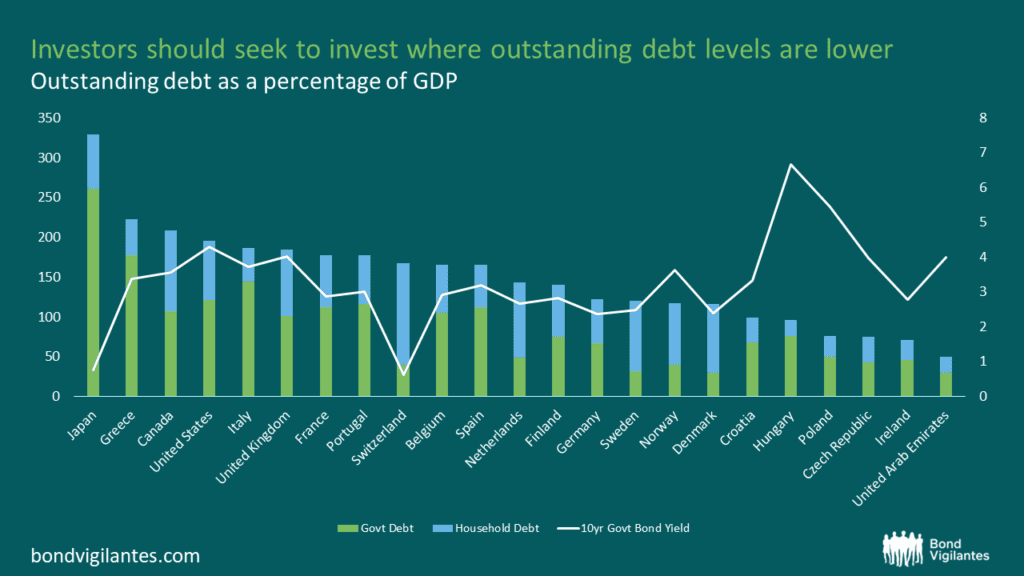
    In these markets that are being totally dominated by what we call the sovereign debt crisis, the market has become fixated on debt to GDP ratios, as corporate bond investors have always paid close attention to companies’ net debt to EBITDA ratios (an income statement approximation to cash earnings). Both ratios very simply look at the level of debt relative to earnings, and thus give some indication of how easily a country or company can service their debts.

    Going into this crisis, countries (not companies) were paying out more in spending than they were taking in tax revenues. And as the bond markets have become not just concerned, but obsessed with starting to reduce debt levels relative to GDP, we have seen austerity budgets passed all over Europe (not the US, but that is something we will all worry about at a-not-that-much later date). These are a direct attempt to bring primary budgets back into balance, where spending is financed through tax revenues rather than increased borrowings. A secondary aim of this is to start to bring down the all-important debt to GDP ratio.

    But governments are finding it very difficult to bring in the necessary budgetary reforms due to political unrest. And now, the few reforms that have been brought in to cut spending have met with what looks like being a global slowdown. Perhaps even a global recession. So governments are not only struggling to bring the primary budget back into balance, but are now seeing GDP growth fall, whether by coincidence, or by actually contributing to the decline in growth (more likely). And if GDP starts to fall, then debt to GDP ratios deteriorate unless total debt levels are being reduced by a faster amount. You won’t find many, if any, examples of states that are actually cutting their total debt levels in Europe yet.

    It is worth observing, in passing, that there are several countries that have pretty terrible debt to GDP ratios that also have historically low interest rates (witness the US, the UK and Germany, amongst others). The implicit message here is that debt to GDP is not the be-all and end-all in terms of the cost of that debt.

    So what is needed, if growth continues to slow and the threat of renewed recession spreads across these over-indebted nations?

    The evidence of the Greeks and the Italians coming and spending such large sums of money on prime London property suggests that these people fear a new wave of fiscal approach to this crisis. As growth in both these states continues to plummet, thereby worsening traditional debt to GDP ratios (bar a haircut or default, both synonymous as far as we’re concerned) a new approach by policymakers may start to take hold. Austerity isn’t going to help in this environment. Perhaps even the opposite. What is needed is an ability to stimulate the economy, so as to generate jobs and growth. And what is all too clear from the last couple of years is that the bond markets will no longer lend to finance these budgets aimed at growth. So the resource needs to come from somewhere else. Is it time for Robin Hood to come to the rescue in the form of a wealth tax? It appears that many citizens of peripheral Europe are starting to fear exactly that.

  • Red screens at night, stockpickers’ delight

    Topics
    Europe, high yield

    Posted November 23rd, 2011

    In this heightened atmosphere of risk aversion, the high yield market as a whole has been far more discriminating when it comes to any poor fundamental performance from individual issuers or sectors. This has led to some large relative moves between certain bonds and sectors within the market. To put it another way, 2011 is turning out to have been a vintage year for stock picking. Those high yield fund managers who have managed to correctly back the “winners” and avoid the “losers” will have significantly outperformed.

    This has been particularly true of one major trend that happens to affect a lot of high yield issuers, namely the shift away from traditional physical and analogue media toward online and digital media.

    This shift has been occurring for years, but the pace of the change in how people consume content has suddenly accelerated in the last 18 months, with profound consequences for many companies within the high yield market.

    One group of “winners” in this case has been the broadband and cable operators in Europe. As people start to watch more digital TV, use more bandwidth intensive services and consume content online, the demand for faster and more reliable broadband and digital TV has increased rapidly. With well invested fibre optic networks and with consumers willing to pay premium prices for premium services, a lot of European cable companies have been enjoying a miniature boom despite the broader travails of the European economy. The latest round of third quarter results from companies such as Virgin Media in the UK, Kabel Baden Wurttemberg in Germany and Ziggo in the Netherlands, have merely affirmed the trend.   (Full disclosure: M&G funds own bonds issued by the companies mentioned).

    The “losers” in all this have been companies who have been involved in the traditional provision of physical media.

    For instance, let me ask you a question: when was the last time you picked up a physical telephone directory?

    Directories businesses (traditionally large issuers in the high yield markets) have been having to cope with gradual structural decline for years. This in itself is not a large negative for creditors. A company that is in decline can still generate a lot of cash and repay its debts. The pertinent issue for bondholders is the pace of decline and whether those debts are manageable.

    What the directory companies have found is that in the age of Google and Facebook, fewer consumers are reaching for the Yellow Pages to find a plumber and are instead reaching for their laptop or smart-phone to type in a search or ask their social circle for a recommendation. As a result small businesses are reallocating their advertising budgets online at an ever-accelerating rate. Directories companies have tried to mitigate the shift by entering the online space but with mixed results.  Consequently, as earnings and cash flow have been falling ever faster in 2011, debt loads are starting to look increasingly unsustainable. Debt restructurings and bankruptcies are becoming a recurring feature of this sector. (Seat Pagine in Italy, for instance, is currently in talks with its bond holders to exchange almost € 1.3bn of high yield bonds into equity)

    The crucial thing for us as high yield investors is that this fundamental trend has been starkly reflected in the performance of the bonds over the course of this year.  As we can see in the chart below, backing the “winners” (in this case senior secured bonds issues by Virgin Media, Kabel Baden Wurttemburg and Ziggo) in green and avoiding the “losers” (senior secured bonds issued by Seat Pagine and Pages Jaune) would have meant a relative outperformance of almost 30% this year.

    As the Eurozone melodrama continues to dominate the headlines, it’s easy to forget that for the millions of European consumers and thousands of companies, life (for now at least) carries on. As it does so, there are many profound shifts within the economy that should not be ignored by investors.

  • Why my dad is being hit hardest by inflation

    Topics
    inflation, UK

    Posted November 22nd, 2011

    Inflation remains a hot topic here in the UK. The latest numbers out last week showed CPI had risen by 5% over the year.  This is only 3% above the Bank of England’s target rate. If inflation remains at this rate for the next 5 years, the buying power of £100 today will fall to £78.35. Ouch! The words of John Maynard Keynes immediately spring to mind: “The best way to destroy the capitalist system is to debauch the currency. By a continuing process of inflation, governments can confiscate, secretly and unobserved, an important part of the wealth of their citizens.”

    I thought it might be interesting to see what the actual experience of inflation was for UK citizens. Obviously, the basket of goods will differ between a student or a pensioner and hence their respective experience of inflation can be very different. Warning – I had to make a few assumptions/guesses along the way (as any good economic analysis inevitably does).

    I have split up the population into four highly simplistic categories; student, parent of a young family, baby boomer, and a pensioner. To assist my guess work, I had a few people in mind. These being: my brother’s girlfriend (uni student), my uncle (parent of a young family), my old man (baby boomer b. 1956), and my granny (age 78). From this highly scientific reasoning I came up with the following inflation basket weights.

    Category UK CPI Student Parent of a young family Baby boomer Pensioner Average of sample
    Food 12% 15% 15% 10% 20% 15%
    Alcohol & Tobacco 4% 10% 2% 5% 0% 4%
    Clothing 6% 3% 5% 5% 5% 5%
    Housing 13% 7% 20% 15% 20% 16%
    Furniture 6% 0% 5% 10% 5% 5%
    Health 2% 1% 3% 3% 15% 6%
    Transport 16% 18% 15% 20% 5% 15%
    Communication 3% 5% 2% 3% 4% 4%
    Recreation 15% 10% 15% 10% 10% 11%
    Education 2% 10% 10% 0% 0% 5%
    Restaurants 12% 15% 5% 13% 5% 10%
    Miscellaneous 9% 6% 3% 6% 11% 7%


    Interestingly, even though it is a very small sample, the average weights of the four people comes very close of the official UK CPI weights. The biggest difference is recreation (the sample proportionately spends less than the official basket) and health (where granny’s basket of goods is weighted 15% towards health).

    Let’s have a look at what the inflation rate was over the past year for the categories that make up the UK’s basket of goods.

    Food 5.00%
    Alcohol & Tobacco 9.10%
    Clothing 3.60%
    Housing 9.10%
    Furniture 5.70%
    Health 3.00%
    Transport 7.70%
    Communication 4.80%
    Recreation -0.50%
    Education 5.10%
    Restaurants 4.50%
    Miscellaneous 2.80%


    It is now possible to calculate inflation across the categories. UK inflation is 5.0%. Inflation for a student came out at 5.4%. Inflation for a parent of a young family is 5.3%. The baby boomer category came out at 5.5%. Pensioner inflation was calculated to be 4.8%. From this analysis it appears baby boomers are being hit the hardest by inflation. If inflation stays at its current rate for my old man, in 2024 he will find £100 will lose half its value and will only purchase £49.86 worth of goods and services.

    What is particularly interesting is that UK pensioners currently make up 16% of the population. This is forecast to grow to 23% by 2035. This demographic trend may have a substantial impact on inflation going forward. As the UK population ages, a greater proportion of the population will be minimising their consumption to save for retirement. This is a deflationary force. Categories like recreation, restaurants, and alcohol & tobacco will likely fall as a proportion of the consumer basket.

    On the other hand, the workforce will become less efficient as workers retire. Highly skilled workers will become more scarce, suggesting employment costs will rise. Production of goods and services and productivity will fall. This is an inflationary force. Categories like health and housing (which incorporates utility bills) will likely grow as a proportion of the average UK consumer’s basket.

    Sir Mervyn King blames the VAT increase and higher import and energy prices for high UK inflation readings. It is nice to be able to look through these effects if you are setting monetary policy, less nice if the rising costs of these items are eating into your retirement nest egg. With the BoE bank rate at 0.5% and unlikely to rise anytime soon, it is hard to find a secure investment which will compensate for the current elevated level of inflation.

    It is rumoured that if you place a frog into a pot of water and slowly increase the heat to boiling, it will not feel it. With the BoE embarking on another round of QE, the water could reach boiling point very soon for UK savers.

  • Ben and Mike get cosy with the Chief Economist and Head of Prices at the UK’s Office for National Statistics

    Topics
    inflation, UK

    Posted November 17th, 2011

    Ben and Mike attended a very informative recent lunch featuring two of the top bods at the UK’s Office for National Statistics and hosted by the excellent Alan Clarke (ex BNP Paribas UK economist,  now at Scotia Bank).  They thought that there could be a great opportunity to share Joe and Pam’s expertise on UK GDP and UK inflation with our blog readers so they phoned ahead and managed to locate both a small camera and a vacant meeting room.  Joe and Pam were extremely kind to agree to jump in a taxi and head over to M&G’s office, where they recorded an impromptu 15 minute video discussing a range of topics from why you shouldn’t read so much into the strong UK Q3 GDP data to why the Retail Price index (RPI) is getting outdated and what the Office for National Statistics (ONS) is planning to do about it.

    Apologies that the sound quality isn’t wonderful but hopefully you’ll find it useful.

    Click here to access the video

Page 5 of 60« First...34567102030...Last »

Follow us on Twitter

For Investment Professionals only. No other persons should rely on the information contained within this website.

Download or order a hardcopy of the 5th Anniversary Bond Vigilantes book and make a donation to Cancer Research UK

5th Anniversary Bond Vigilantes book

Follow us by RSS

Bond Vigilantes

Bond Vigilantes News Feed

Search Bond Vigilantes

Sign up for exclusive email updates from the Bond Vigilantes

The information we collect from you is used solely for the purpose of notifying you of updates to the www.bondvigilantes.com website.


* = required field

Who we are following on Twitter

Bond Vigilantes Twitter Feed

Recent videos from iView

By clicking on these links you will be visiting iviewtv.com

Next iview