





I had lunch last week with a Bank of England MPC member, and I asked him why the Bank didn’t cut rates below 0.5% in order to help the banking sector improve its Net Interest Margins (NIMs) and thus its capitalisation. The MPC member replied that it was a matter of record that the Bank had discussed a rate cut in the Autumn but rejected it because of some technical reasons around the operations of the money markets (which nobody seems able to fully explain) and because the feed through into the banks’ funding costs would likely be limited.
I disagree that there would be no benefit in a Bank rate cut, and the news this weekend that Halifax is raising its mortgage rate from 3.5% to 3.99% for 850,000 Standard Variable Rate (SVR) mortgage borrowers will help show why. Halifax (HBOS) needs to improve its margins and become profitable before it will be able to increase its lending to the UK economy and slow its delevering. The method it (the state?) has chosen to improve its margins is to raise the interest burden on UK consumers (by 14% to those on the SVR). This is a zero sum game to the UK economy (consumers lose by the amount that the banks gain – there might even be a negative multiplier effect as the banks use their gain to delever whilst the consumer stops spending to the extent of their loss?), whereas if the Bank of England cuts rates (to near zero) many of the funding costs that directly impact HBOS, including LIBOR and 5 year interest rate swap rates would also fall. HBOS wouldn’t need to pass on these rate cuts to customers, but the mortgage borrowers are not worse off, and the banks have improved their margins. So the Bank of England should cut rates later this week – the impact will of course be relatively small as we reach the “zero bound”, but it is probably more certain in its effectiveness than a theoretically equivalent amount of Quantitative Easing.
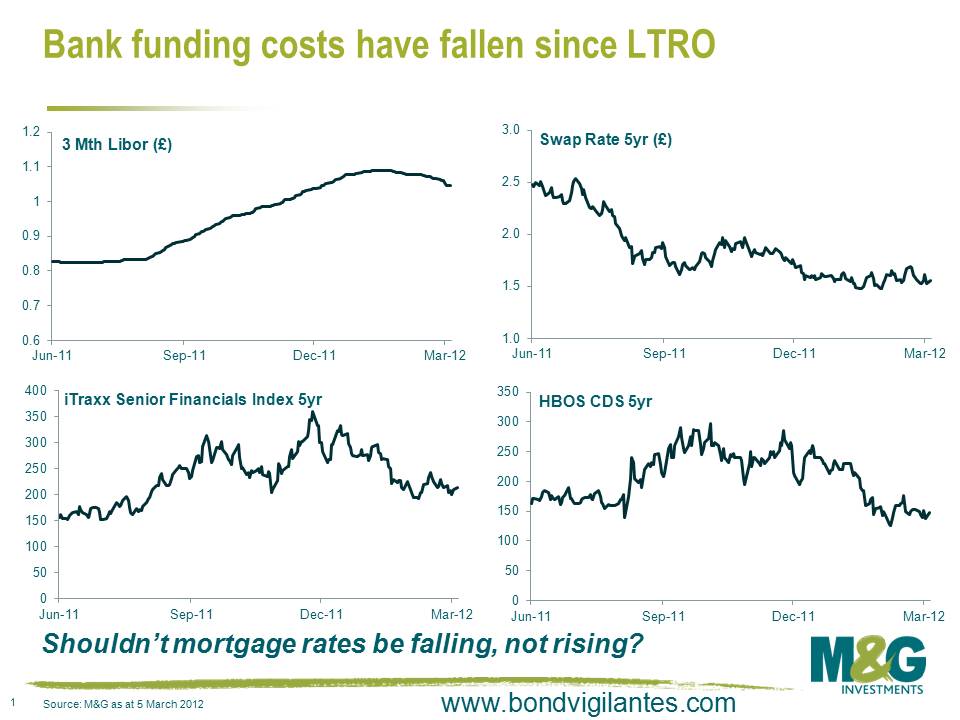
Finally, the papers I read this weekend talking about the Halifax SVR rate increase said that the reason for the hike was due to increased funding costs in the wholesale markets. But is that true? I’ve put 4 charts together here. They show that 3 month LIBOR rates (a measure of short term money market costs) have fallen year to date (albeit marginally), that 5 year swap rates (a measure of fixed rate mortgage funding costs) remain around record lows, and that senior CDS spreads for both European banks in general and HBOS specifically are both much lower than their 2011 Q4 highs. So if anything, since the ECB announced its 3 year LTRO facilities, the both cost of funding and the availability of liquidity for the banking sector have improved – and mortgage rates in an ideal world should be falling.


With all due respect for his banking colleagues, the author forgets to mention the humble “saver” in this equation. His argument is for confiscation of wealth from the saver to blatantly help increase profits at the banks. He argues for redistribution of wealth from saving waitresses to irresponsible borrows who can’t withstand a 50bp rise in their mortgages.
And to make sure I get this; the author is upset that the BofE didn’t legislate more profits at banks because they did not lower rates below .5%. Part of me wants to vomit and part of me want to cry “have you no shame!”
How much lower do he want below .5%?
Do he really want his banking buddies to have free money?
if the banks can’t make money at .5%, with mortgages at 3.5%, they deserve to wither on the vine. Most businesses would love a 85% gross margin. I am not even sure highly successful drug dealers get that margin.
Like John Locke argued nearly 300 years ago, I would argue that the BofE should not even have the power to set interest rates. It is pure folly that leads to bubbles and dislocations. The only think it allows is for the BofE to legislate profits for their special interest friends – but I guess I am a crazy free market guy.
Hi crazy free market guy
The reason that global capitalism has come close to the brink in recent years is down to excess borrowing. Of course it is moral hazard to bail out borrowers, especially when sensible savers are being punished as a result. But until the excess leverage is worked out through asset sales, recapitalisation and a return to profitability, global growth will be well below trend – and that doesn’t help anyone, including those saving waitresses you mention. In the meantime I’d rather Halifax returned to being viable through lower funding costs, than through hiking mortgage rates on the other side of the equation. As I said, I think that model has a greater net benefit to society – as we’re doing philosophers from 300 years ago (well nearly), I give you Jeremy Bentham. “It is the greatest happiness of the greatest number that is the measure of right and wrong”.
Jim,
I agree with you on that. Though bear in mind, that it is not down to excess borrowing, but to excess lending. Very different story!
>>> This is a zero sum game to the UK economy (consumers lose by the amount that the banks gain – there might even be a negative multiplier effect as the banks use their gain to delever whilst the consumer stops spending to the extent of their loss?), whereas if the Bank of England cuts rates (to near zero) many of the funding costs that directly impact HBOS, including LIBOR and 5 year interest rate swap rates would also fall. HBOS wouldn’t need to pass on these rate cuts to customers, but the mortgage borrowers are not worse off, and the banks have improved their margins. <<<
Jim stresses the “zero-sum” aspect of the banks’ increased profitability coming at the expense of borrowers’ (mortgage holders’) increased interest costs.
I agree.
But the same zero-sum applies should base rate be cut below 0.5%. It’s a simple identity relationship that any benefit to mortgage holders will be balanced by the disbenefit to savers. There are no free lunches available.
Now, it may be a political decision to further benefit borrowers at savers’ expense, but pretending that this isn’t also a zero-sum game is fooling no one.
Furthermore, as at least Bill Gross recognises, at or around the zero bound for rates, liquidity trap risks come to the fore.
Excellent article Jim.
I totally agree with your comments and really appreciate your investigation in Bank funding costs. Everything you do say you back up with empirical evidence which gives it the necessary credibility. I always try to back up my arguments with the same style.
It is really interesting to view the comments from BT. This is clearly a disgruntled saver who feels let down by many policy responses designed to not let the banks fail. As a financial adviser with a background in Economics, allowing the banks to fail would have been absolutely devastating and a necessary evil. Surely it is better to have savings returning nothing than have seen your savings disappear.
Additionally, there are more asset classes than just cash and given the moral hazard situation created over the last 3 years it has paid to take risk.
The other factor to consider is the rates needed to attract deposit money. These, by some miracle, do seem to be rising and the saver can somehow demand a better return. I really do not know how or why this is happening but retail rates seem to have detached from money market rates. The BoE’s ability to engage in financial repression has limits it would seem.
>>> As a financial adviser with a background in Economics, allowing the banks to fail would have been absolutely devastating and a necessary evil. Surely it is better to have savings returning nothing than have seen your savings disappear. <<<
This is a straw man argument. Banks had plenty of loss-absorbing capital to take a hit before depositors would have been reached. But in the heat of the moment a few folks bottled it, and the decision was taken to bail out bondholders. If a different course had been chosen, I’ve no doubt that anyone with deposits below the FSCS guarantee level would have lost a penny, and my expectation is that no depositors with balances in excess of that level would have lost anything either.
Of course, the banking system would have needed to be nationalised and then subsequently refloated, and the recession would likely have been rather deeper than it was, but I’d argue that the basis for a subsequent organic recovery would have then been in place, as opposed to a situation now where never-ending emergency policy responses are required in order to keep the patient (barely) alive.
Decisions that make for short term relief rarely prove to be the correct longer term decision, not least because of the unintended consequences those short term decisions give rise to.