






South Africa should be rated junk, and that really matters if you’re an EM debt investor
The worrying developments in South Africa in the past few months have caught the attention of the ratings agencies and the markets (see first chart). South Africa is one of very few emerging market countries whose credit rating is deteriorating; it’s still officially rated investment grade, but we think it should already carry a junk credit rating and the market is not pricing this in. And considering that the country has a 10% weighting in a commonly used EM local currency benchmark, this really matters for EM debt.
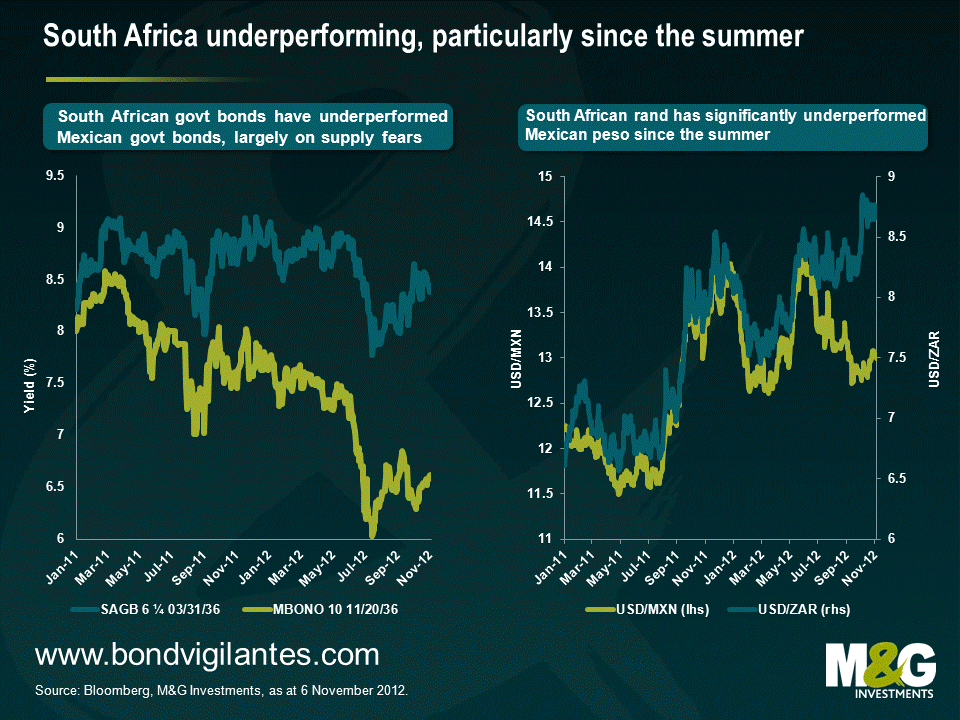
South Africa faces a number of financial, political and economic issues, none of which appear likely to be resolved quickly or easily. Some of the problems, and especially those that the rating agencies reacted upon, are well known and widely discussed (namely gold and commodity export dependence, crime and social unrest, stubbornly high unemployment and income inequality, corruption and poor governance, unionisation and labour market rigidities, and a poor climate for investment culminating in renewed threats to nationalise mining companies). The Economist has done some good pieces covering many of these topics, eg see here.
We think the market and rating agencies continue to underestimate the following issues regarding South Africa;
1. Debt sustainability
Although the central government debt/GDP ratio appears manageable at around 43%, or 60% of GDP including guarantees provided to state owned companies, this does not reflect the increasing debt burdens of local governments and municipalities. Getting accurate figures for local government borrowing is difficult, but the finances of several municipalities appear unsustainable, compounded by massive IT failures which have left thousands of bills unaccounted for. In addition, state owned utilities have also struggled to manage billing and revenue collection, reporting large uncollected debt balances owed by citizens. There are also cases of large arrears being run by local governments themselves, failing to pay for goods and services provided by, for instance, water boards as well as other state and private companies. As in Greece and Italy, payment arrears can comprise a significant portion of government ‘borrowing’ which is typically under-reported in official statistics.
2. Limited fiscal headroom
According to an analysis by Fitch, 90% of South African government spending is on current items such as wages, subsidies and interest, leaving very little available for longer term investment to fuel sustainable growth. At the same time, this also implies limited ability to absorb any significant rise in interest finance costs or any other external shock. In this context, the fact that around 90% of government debt issued is denominated in domestic currency suggests lesser vulnerability to a significant exchange rate shock. However, a large proportion of debt is now held by foreigners which means that exchange rate volatility could have a considerable impact on South Africa’s ability to refinance.
[More generally, a spike in foreign ownership in most EM local currency markets remains an acute concern to us, which is something we’ve repeatedly highlighted on this blog over the last year or so such as here. Investors and EM policy makers I’ve spoken to remain far too complacent about flows into local bond markets (historically, EM debt crises have tended to follow big jumps in external debt levels and everyone is very sensitive to this, but foreign buying of local EM markets is a relatively recent phenomenon). Interestingly, however, the IMF are starting to focus on foreign ownership of local currency bond markets as a key risk, eg see page 67 onwards in the IMF’s recent GFSR. Note that foreign ownership of domestic bond markets isn’t solely an EM country problem – Australia stands out on this measure too as previously discussed here]
3. Implicit support of the banking sector increases sovereign liabilities
Another critical issue is the separation of the South African banking sector from government implicit support. To date, the population (and most investors) have taken it for granted that the government would stand behind the five largest banks, which account for 90% of deposits. As a result, there has been a lack of progress on implementing deposit insurance, let alone on implementing global banking reforms such as resolution regimes. The banking sector, therefore, remains essentially a contingent liability of the sovereign. The local banks, in turn, have leveraged this assumption by raising significant amounts of wholesale debt. They also remain very short term funded, with heavy reliance on local money market deposits from local insurers and pension funds. Consequently, these have built up massive exposures to the banking sector – again in the expectation of government support for the banks if needed.
Let’s think this through. Adding further government liabilities of about.90-100% of GDP to the existing ones in order to support the banks (and even more, if the insurers and pension funds themselves also have to be supported because of their investment concentrations in the banks) clearly creates an unsustainable burden on the sovereign. South Africa is gradually waking up to the fact that it cannot maintain an implicit bank support policy while also retaining strong investment grade sovereign ratings – these two are incompatible, as much of Europe has discovered. However, introducing some sort of resolution planning that avoids taxpayer support for banks will require major structural reform, including deposit insurance, bail-in of wholesale liabilities and balance sheet shrinkage, none of which will be popular in the short term.
4. Current account deficit
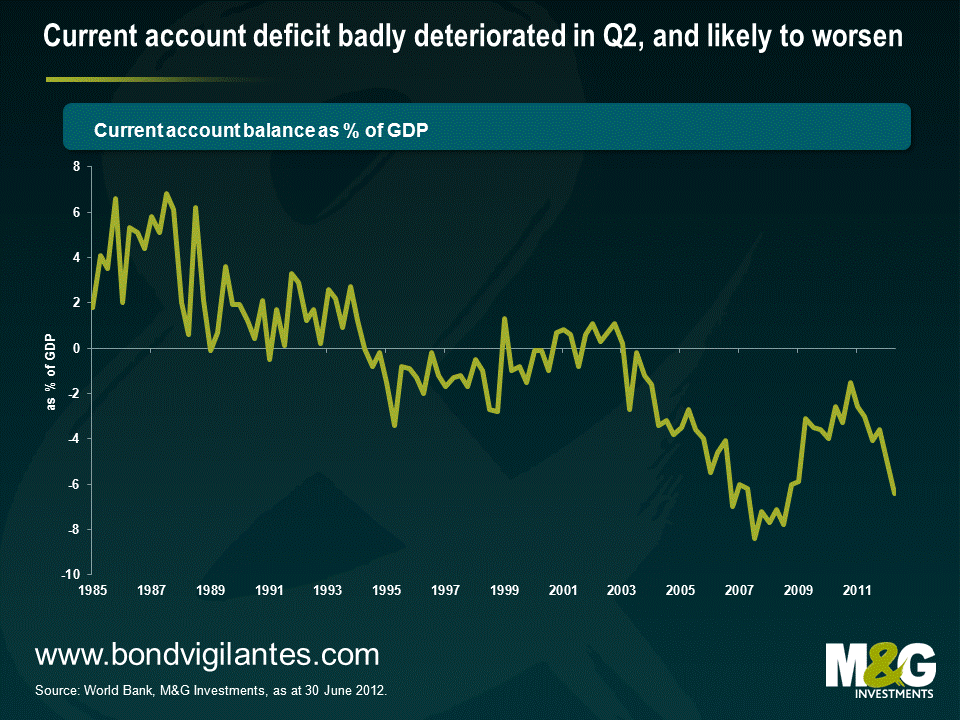
Despite the commodity boom of the last decade, and despite the fact that 42% of exports are currently in the form of commodities, South Africa has had a current account deficit since 2003. More strikingly, the lack of investment in critical sectors such as mining have not only led recently to labour unrest, but have also contributed to a declining productivity and competitiveness in those sectors which South Africa is highly reliant upon (a member of the South African Treasury I met at the beginning of this year cited a lack of investment as one of the country’s most critical problems, and recent unrest will hardly accelerate much needed FDI). Meanwhile, consumption of imported finished goods has continued to rise as domestic productivity has deteriorated in these sectors. The country’s increasing dependence on gold exports, which account for 25% of all exports, as well as on China, where around 15% of the exports go to, makes it increasingly vulnerable to external shocks. The high dependency on China worries us in particular, as we believe that China is in a structural slowdown rather than a cyclical slowdown as we’ve previously explained. If our China thesis is correct, it would have major implications for global demand for hard commodities and raw materials and would put pressure on countries reliant on exporting these commodities. Again, many of these issues are things that South Africa has in common with Australia.
While it’s true that the four points above apply to varying degrees to a number of developed and developing countries, South Africa doesn’t look like an investment grade country to us when taken together with the issues previously highlighted. If the rating agencies follow this assessment – and their latest actions show a clear tendency – then this could have major implications for South African debt and currency markets. South Africa has only just entered the widely used Citi World Government Bond Index (and enjoyed large inflows from foreign investors on the back of this) but would rather embarrassingly drop out again if it were to be junked. Interest rate costs for not just the sovereign but banks and corporates would rise, potentially sharply, and the South African rand could slump (South Africa has few reserves with which it can intervene in FX markets).
If South Africa were to be junked, what would the impact be on EM debt more generally? In terms of direct effects, given a 10% index weighting in EM local currency debt, a drop of, say, 10% in the rand and 5% in the bonds’ prices would detract 1.5%. South Africa has a smaller weighting in external sovereign and corporate debt indices (typically 2-4% depending on the index) so the impact would be less. Indirect effects are impossible to quantify; at the very least other African countries would likely be hit (many of whom run even larger current account deficits) although these countries form only a small part of the EM debt indices. It’s possible that investors will reawaken to idiosyncratic EM risks and contagion could spread to other regions.
It’s important not to over-blow the systemic risks, and bear in mind that events in the Eurozone, the US and China will obviously be far bigger drivers of returns for the wider EM debt market than events in South Africa. Nevertheless the message remains -EM debt, not so safe.
The value of investments will fluctuate, which will cause prices to fall as well as rise and you may not get back the original amount you invested. Past performance is not a guide to future performance.


19 years of comment
Discover historical blogs from our extensive archive with our Blast from the past feature. View the most popular blogs posted this month - 5, 10 or 15 years ago!


Bond Vigilantes
Get Bond Vigilantes updates straight to your inbox