Page 1 of 1212345...10...Last »
richard_woolnough_100

The King speech

Today is the last inflation report for Mervyn King, Governor of the Bank of England. He has served the bank for many years and has been the key figure at the bank for the past eight years.

King’s abdication (retirement) is a time to reflect on his achievements at the top. A keen football fan who happily uses soccer analogies, King would probably recognise his time as Governor has been a game of two halves.

The first half was great, with no apparent need to interfere with a perfectly balanced, strong growth, low inflation economy. The second half involved a great deal of stress and the need for intervention as the economy was weak, the inflation target was constantly missed, and he faced the financial equivalent of Chernobyl, as the banking sector began to meltdown.

King is not only a football fan but is also a regular sight at Wimbledon. Rudyard Kipling’s poem ‘If’ is the guide to how players should play on its perfect English grass courts. It is fair to say that King has appropriately treated success and failure in the same way.  I would argue that his failures were in the first half of his term and his strength and ability shone through in the second half of his term. Although his critics may say that the seeds of the financial crisis were sown under his watch.

I think the seeds of the UK financial crisis were as follows:

Inappropriately low interest rates in the USA following the tragic events of September the 11th.

The removal of bank supervision from the Bank of England by Gordon Brown.

The need to hit a rigid inflation target when the world was enjoying low inflation because of world trade and productivity growth meant the use of over stimulative policy, causing a boom to keep inflation on target.

The euro creation resulted in an unstable financial system in Europe.

The first three of these have been resolved with the passage of time, a change in UK banking regulation back to the old ways, and a move around the world to more flexible inflation targeting. The last – the issue of banking in the eurozone – remains unresolved, but there are strong signs that potentially successful attempts are underway to solve the dichotomy of banking support from sovereign states within the eurozone.

We are avid watches of the inflation reports, and will be watching it today. The journalists get to ask questions. If I was there these are the three I would like to ask:

1. What do you think of the euro as an economic concept?

2. How close were we to financial Armageddon?

3. How does QE work?!

Sadly I think Mervyn will be as discreet as always in the press conference. Let’s hope that when he is allowed to speak freely, we get to see a little less candour and more transparency and insight into what has been an exciting time to be at the bank.

I think history will show that Mervyn King did a good job in handling the crisis. After all, that’s what central banks were created to do as lenders of last resort. From an economist’s point of view, what does his leadership prove? Well, Goodhart’s law was again proving itself to be correct. You aim to be a boring central banker and look what happens!

jim_leaviss_100

Do Central Banks tell us too much for our own good?

I read in The Times last week that the Shadow Monetary Policy Committee (a panel of economists and Bank of England alumni) thinks that the Bank of England should announce a freeze on UK rates for an extended period of time. The Federal Reserve also had this policy (now replaced by even more explicit guidance about the unemployment rate and inflation levels), as did the Bank of Canada. In the past few years the Fed has spent weeks debating its communications strategy. Elsewhere we get monthly press conferences (including in Trichet’s time as head of the ECB the use of the explicit codewords “strong vigilance” which meant “rates going up next month”). We also get Inflation Reports and Financial Stability Reports, fan charts and GDP forecasts from which market economists pronounce that the Bank’s two year ahead projection means no more QE just yet. I wonder though whether we’re being given too much information, and that in telling us exactly what they are going to do, central banks risk either a) having to not change their policy even if economic circumstances mean that they should (for example if economic growth comes back strongly yet they’ve promised to keep rates on hold for years), or b) lose face, credibility and trust with the market by going back on their promise. Each of these actions has a cost, and should lower an economy’s potential GDP rate.

Is the promise of low rates forever fuelling the return of those Four Horsemen of the Bondocalypse – CLOs, PIK notes, CCC rated high yield issuance, and mega – LBOs? Does it lead to complacency in investment? To schemes that can only survive if rates don’t ever rise? Is current central bank policy generating asset bubbles? And what are central bankers left with, without the ability to surprise and shock? Worse still, what if “low rates forever” has the opposite effect than intended? Does it say “doomed, we’re all doomed”? Perhaps central bankers should realise that keeping us guessing is their most powerful tool (OK maybe QE Infinity is their most powerful tool, but still).

The clip below is of Diego Maradona, scoring against England in the Mexico World Cup finals in 1986.

I was reminded of it when I picked up a copy of Steve Hodge’s autobiography The Man With Maradona’s Shirt in the sales. Maradona was fortunate enough to swap shirts with Nottingham Forest legend Hodge after that game. Anyway, back in 2005 Bank of England Governor gave a speech in which he said the most interesting thing a central banker ever said.

“The great Argentine footballer, Diego Maradona, is not usually associated with the theory of monetary policy. But his performance against England in the World Cup in Mexico City in June 1986 when he scored twice is a perfect illustration of my point. Maradona’s first “hand of God” goal was an exercise of the old “mystery and mystique” approach to central banking. His action was unexpected, time-inconsistent and against the rules. He was lucky to get away with it. His second goal, however, was an example of the power of expectations in the modern theory of interest rates. Maradona ran 60 yards from inside his own half beating five players before placing the ball in the English goal. The truly remarkable thing, however, is that, Maradona ran virtually in a straight line. How can you beat five players by running in a straight line? The answer is that the English defenders reacted to what they expected Maradona to do. Because they expected Maradona to move either left or right, he was able to go straight on. ”

If Maradona had put out a press release and a booklet explaining exactly what he was going to do, it could never have happened. But by keeping the England team guessing and by shifting his weight from left to right (the footballing equivalent of raised eyebrows) he scored the greatest goal of all time.

jim_leaviss_100

Central Bank Regime Change: an update following the Fed last night, and Carney the day before

Last night’s move by the Federal Reserve to change its approach to US monetary policy to effectively reduce the focus on the inflation target was just the latest step in an accelerating project by the world’s monetary authorities.   In a world where unemployment rates are well above pretty much anyone’s estimate of the natural rate, and in many geographies well above 10%, the need for growth is seen as much more pressing that the fear of missing the 2% inflation targets.  So at the latest FOMC meeting the Fed decided that inflation would be tolerated if it nudged higher to 2.5% as long as unemployment remained too high (above 6.5%).  You can read the text of the Fed’s statement here.

We call this move by the world’s authorities away from the old idea of 2% inflation targets Central Bank Regime Change.  We wrote this blog about it in March. The chart is worth showing again.

central bank regime change

The chart from the IMF shows us that in the period post Paul Volcker’s appointment to the US Fed in 1979 (the orange line), the monetary authorities kept interest rates higher than the rate of inflation (they were reacting to the damage that inflation caused in the 1970s).  As a result inflation steadily fell – and as well as high “real” rates, the rhetoric was all about inflation (inflation targets, the Bank of England’s Inflation Report, independent central banks).  It’s been an awesome 30 years (on the whole!) to be a government bond investor, as yields fell in response to inflation fighting credibility.  However, I’ve added another line to the IMF chart (blue), showing how central banks have behaved since Lehman went bust, and the credit crisis was followed by the sovereign debt crisis.  It’s a very different story, with sharply negative real yields.  Nominal interest rates are near zero in much of the developed world, yet inflation has been sticky above 2%.  This is deliberate central bank policy – negative real rates are designed to make it attractive to borrow to invest and stimulate growth (and to deliver gains to indebted consumers), and also to encourage risk taking as investors reach for yield (government bond investors buy credit, investment grade investors buy high yield etc.).

Negative real rates also have an impact which we’ll discuss in more detail another time – debt reduction for bust governments.  There are a few ways to reduce debt burdens:  strong real growth (seems out of reach for the foreseeable future), austerity (unproven and probably counter-productive, although some point to Canada and Sweden as success stories), default (will be necessary for some Eurozone economies without their own currency to depreciate) and inflation.  It’s the last that’s likely to be effective – and as the red line on that chart shows, it’s the method by which the western economies reduced the war debts following WWII.

So whilst we don’t believe the world’s central bankers and finance ministers are sitting high in some Swiss cable car complex, stroking white fluffy cats and cackling maniacally, plotting to generate super high levels of inflation, this is becoming the pragmatic (only?) response to a world without other policy responses (no fiscal flexibility left).  Now the Fed’s latest move to target both inflation AND unemployment rates is very interesting – when I was a young student of economics, the idea that you could chose BETWEEN inflation and unemployment was discredited.   To quote, er, Wikipedia on that idea, known as the Philips Curve “while it has been observed that there is a stable short run tradeoff between unemployment and inflation, this has not been observed in the long run”.  So the idea that you can choose both is probably even more far fetched.

Anyway, what does the Fed’s action mean?  Well watching Bernanke’s press conference last night it struck me that in changing the Fed’s guidance away from the “no hikes until 2015” towards the unemployment and inflation numerical targets should actually be seen as a potential monetary TIGHTENING.  After all, we are exceptionally bullish on US housing as a driver for growth in 2013 and 2014, so if things go well we could end up with the Fed raising rates ahead of the old 2015 date.

So I’ve asserted that Central Bank Regime change is taking place, but I thought it would be worthwhile to put together a brief list of the evidence so far.  Here it is.

Evidence for Central Bank Regime Change

  1. The level of real rates set by the Central Banks: the best evidence is obviously shown on the graph itself.  Are central bankers hitting inflation targets?  Not really – for example the Bank of England has only had CPI at or below the 2% target for 6 months in the last 5 years, and for much of that period it’s been above 3% (and above 5% at one point!).  On latest data the UK, the Eurozone and the US all have negative real rates of 1.75% or higher.  Western central banks are even considering setting negative NOMINAL interest rates.  Only Japan of the major economies has positive real rates at the moment – although we think this might change dramatically, as I’ll discuss below.
  2. The US refocus on the dual mandate: after three decades of inflation targeting, the Fed has been moving towards this new objective for a year or so now.  First Charles Evans of the Chicago Fed started floating the concept of an unemployment target, then Janet Yellan (Bernanke’s probable successor) of the San Francisco Fed joined him, leading up to last night’s actions.  This was pushing on an open door for Ben Bernanke who has written the following in his previous academic life…
  3. Bernanke’s 4% inflation target for Japan:  in this paper, Japanese Monetary Policy: A Case of Self-Induced Paralysis, written whilst he was at Princeton in 1999, Bernanke argues that the solution for an economy like Japan with a burst property bubble, broken banks, sluggish growth and deflationary pressures should be to target inflation of between 3% and 4%.  Looks similar to the US situation, so why wouldn’t Bernanke think that this is the correct response from the Fed for the US?
  4. Mervyn King’s softening stance on the inflation target:  I guess actions speak louder than words, and the lack of actual inflation targeting in the UK for the last 5 years should tell you more than any speech, but I’d never heard the Governor soften his rhetoric until these words in this speech Twenty Years of Inflation Targeting this October.  “There may be circumstances in which it is justified to aim off the inflation target for a while in order to moderate the risk of financial crises”.
  5. New Bank of England Governor Mark Carney talks about a new regime of nominal GDP targeting rather than pure inflation targets: in a speech to the CFA Society of Toronto this week, Carney (who takes over at the BoE next year) suggested that when policy rates approach 0% (the “zero bound”), targeting nominal growth might be more effective than targeting inflation rates.   He even used, for the first time from a central banker (?) the term “regime change”.  “Under Nominal GDP targeting, bygones are not bygones and the central bank is compelled to make up for past missed on the path of nominal GDP.”   Of course, targeting nominal GDP is a very effective way of reducing debt levels in an economy too.
  6. Japanese regime change, the “Abe Trade”: this weekend Japan goes to the polls with opposition leader Shinzo Abe of the LDP favourite to emerge as the new Prime Minister.  Japan has yet to recover from its bust, decades ago, and Abe wants to aggressively target growth.  With deflation of 0.4% in Japan despite the BoJ’s 1% inflation target, Abe wants the central bank to do MUCH more.  This would include raising the inflation target to 2% (or even 3%) and doing whatever it takes (more QE, currency intervention) to achieve that.  This is a manifesto commitment that might get watered down at a later date – but having seen a BoJ member in Tokyo recently I get the feeling that a hike in its inflation target is inevitable.
  7. Europe: hard evidence is more difficult to find, but with hawkish German ECB members like Axel Weber and Juergen Stark both resigning in 2011 (“It’s generally known that I’m not a glowing advocate of these (bond) purchases” – Stark) the ECB has been much more open to extraordinary balance sheet expansion (LTRO, SMP, OMT).  And to more “traditional” Quantitative Easing at a later date?

So with all of this evidence that the authorities are changing how they think, and act, on inflation, you would expect that bond markets would have reacted badly right? If Ben Bernanke thinks 4% is an appropriate level for inflation in the US, you wouldn’t be lending money to the government at 0.65% for the next 5 years would you? And with Mark Carney taking over at the BoE next year, breakeven inflation rates (i.e. market inflation expectations) would be overshooting the 2% inflation target over the next few years too? Well 5 year Treasury yields are still well below 1% (helped by QE buying of that sector, announced last night) and UK breakeven inflation rates on a CPI basis are below the 2% inflation target. In both cases it feels as if state intervention in these markets (financial repression through QE, capital requirements etc.) will keep yields low despite high inflation. And this is entirely necessary – with half the US Treasury market maturing in the next 3 years or so, if yields ever did adjust higher then western governments, with marginal solvency in any case, could go bust quickly.

ben_lord_100

Panoramic: central bank regime change – inflation targeting or inflation hunting?

Given the success that central banks have had in targeting inflation over the last decade or so, the recent increase in their powers, and the broadening of their remit to include economic growth, has been largely welcomed by the markets. But have we put too much faith in central banks abilities? And, with record levels of peacetime government deficits and the clear political incentive to tolerate higher levels of inflation, have we come to overestimate their commitment to reining in prices?

In this note, which is part of our quarterly Panoramic series, we argue that we are seeing potential upside risks to inflation as central banks continue to preside over the biggest coordinated global monetary stimulus that we’ve seen in recent history. In our view, the expansion of central banks’ balance sheets signals an unspoken shift in these institutions’ remits that could have important consequences for future inflation rates. It is a phenomenon we have coined “central bank regime change”.

The Bank of England and European Central Bank seem no longer to be primarily focused on delivering price stability. Their new mandate now covers supporting domestic banking systems, offsetting the effects of government austerity measures, bolstering trade and implementing the conditions needed to generate jobs and economic growth.

With central banks’ macroeconomic responsibilities straying ever further into what was previously the state’s domain, their independence is looking increasingly fragile. The hijacking of monetary policy by politicians cannot be ruled out, especially if it enables them to inflate their way out of their growing debt burden. If we get to this stage, inflationary pressures will rise, although central banks’ credibility will be tarnished and policy responses rendered ineffective.

In our view, there are potentially plenty of reasons to expect the current period of low inflation to come to an end. Central banks are still thinking of new ways to ignite growth and they appear to be increasingly tolerant of above-target inflation. But are they moving ever closer to a major policy error that could ruin their inflation-targeting credibility? And should we all start thinking about inflation again?

To read the latest Panoramic, please follow this link.

richard_woolnough_100

ECB to ECP (European Centre for Politics)

The ECB is modelled on the idea of an independent central bank, where decisions are made to enforce economic rather than political discipline. Recently however, its role and mandate seem to be changing.

This move by the ECB to become more an arm of the state is typified by Mr Weidmann’s comments recently. He draws comparisons of the recent potential bond buying announcement, with that of aggressive state financing via the printing of money by non independent central banks.

Not only has the ECB agreed to become more like an arm of the state, it is potentially attempting to become the state. Its bond purchase programme is dependent on a sovereign state meeting certain conditions, which means it is now aiming to have the powers of a state, in terms of controlling net taxation and spending. It would therefore control the printing press and control expenditure. It would then automatically face the tricky political task of switching the printing press off if conditions are not met by its subjected member state. No wonder Mr Weidmann does not approve.

This is not the only way the central bank has become more political recently. By having the explicit aim of saving the euro at all costs it has basically made a political decision. Currency unions are by definition a political construct. Therefore, its recent move to a dual mandate of inflation targeting and saving the euro is a move towards a more politically focused ECB.

One of the problems the ECB faces as a political animal is its construction. It has not exactly been constructed in an efficient, democratic manner. Firstly, one country one vote means proportional representation is out the window, potentially annoying the larger members who do not agree with the policy and have to pick up the bill (Germany). Secondly, the appointment of its council members is undemocratic. Thirdly, council members, as national central bank governors, tend to be economists!

There is always a connection between a central bank and the state that it is theoretically acting in the independent interest of. The ECB is becoming more like the ECP (the European Centre for Politics). Will European governments give it this increasing power? Will it be able to exercise this power correctly?

richard_woolnough_100

Climate change – bzirc monetary policy

As investors we get used to living within certain recognised bounds. For example, it has been commonly assumed that interest rates cannot be sub-zero. There has been the odd historical quirk when we’ve seen negative rates (Switzerland in the 1970s), but that’s more for amusement than general investment consumption. However, there now appears to be the potential for a major investment climate change.

There are already plenty of bond markets now living in the sub zero ice age, such as Switzerland, Denmark, Germany, Finland and the Netherlands. In these cases, the existence of negative rates could be down to the desire to express a currency or re-denomination view (as Mike previously wrote), so may be seen as a by-product of external factors and not of domestic monetary policy. However, there is now the potential for G7 monetary policy to enter the previously unbelievable reality of official sub-zero rates.

Many G7 economies have implemented very low rates and quantitative easing for a number of years, yet still appear to be in the economic doldrums with high unemployment, low growth and limited fiscal room. It could now be time for a significant change in the investment text book as central banks experiment with rates below zero.

Theoretically, a negative interest rate sounds simple – you put £100 in the bank and you get £99 back a year later if the rate is -1%. A  rational investor would of course have the alternative of simply keeping their cash under the mattress and not suffering the negative rate, although the incentive to behave rationally would be limited by the administrative burden and security risk of holding cash.  The central bank could simply limit this activity by basically not printing enough cash. Therefore the vast majority of money would have to be held electronically and could therefore suffer a penal negative rate. Implementation of sub zero rates is possible.

From a central bank’s point of view this should be stimulative, as it would discourage saving and encourage consumption like any traditional interest rate cut. At the extreme you could create exceptionally low, zero, or even negative borrowing rates.

The challenges faced by central banks and governments are still there despite traditional and unconventional policy action. Maybe it will soon be time to use the conventional tool of cutting interest rates in an unconventional way by making them negative. The next step to be taken by the authorities might mean economies working in a below zero interest rate climate (bzirc monetary policy).

richard_woolnough_100

UK gilts – “Whoah we’re half way there, Whoah livin’ on a prayer…”

Last week the Bank of England announced a further round of quantitative easing of £50bn, bringing the total to £375bn. It is obvious that the MPC thinks that monetary policy is still not sufficiently loose to create the desired economic effect and hence further stimulus is needed.

We have written numerous times on QE. When we started scribing on this novel experiment we focused on why it needed to be done, and how it was meant to work (like walking on custard) and the bizarre effect this may have on the bond market.

One thing we did not focus on was the length of time monetary policy would have to be kept super accommodative, though we did expect it to be for an extended period of time (certainly until we begin to see a meaningful recovery in employment outcomes as outlined here).

Mervyn King appears surprised by the extent of the crisis. The MPC were slow in aggressively cutting rates after the onset of the credit crunch in 2007, but to his credit Mervyn and the UK authorities have been at the forefront of corrective action and have correctly realised the severity of the credit crisis. The MPC was correct to not interpret the inflation scare of 2008 or the economic rebound of 2009 as economic recovery. They have been spot on.

But how accurate is his current thinking?

The Governor is not one to pre-commit. However he did say something recently that shows how he feels about the potential long term outlook for rates. At the latest Treasury Select Committee he repeated that at this point in time – and he has said it at every committee meeting – that he believes we are not yet half way through the crisis.

“When this crisis began in 2007-2008, most people including ourselves did not believe that we would still be right in the thick of it, in the middle of it, quite this late. All the way through, I’ve said to this committee that I don’t think we are yet half-way through – I’ve always said that and I’m still saying it.” Mervyn King, June 26, 2012.

From the chart below we can see that BoE base rate has been set at 0.5% since March 2009, and over £325bn has been pumped into the financial system through QE. If we are not yet half-way through this crisis, then this implies that rates will stay at these levels for at least another 3 years to 2015, and a further round of £375bn of QE is potentially on the agenda.

If this interpretation of the outlook turns out to be correct then these very low levels of short and long term gilt yields begin to look more logical to gilt investors. And we can assume that the UK won’t recover fully until the US and Europe does as well, which means that ultra low yields on Treasuries and Bunds may also make sense.

Monetary policy is living on the edge, and if Mervyn King were to do a turn at a city karaoke machine, then the bar could well be ringing out to this Bon Jovi classic…

“Whoah we’re half way there, Whoah livin’ on a prayer…”

Naturally, his audience of gilt investors – despite the ultra low yield they are currently receiving – will sing back “We got to hold on to what we’ve got”.

The “safety race”: the systemic implications of the bank asset grab

Anyone monitoring the risks in the global financial system knows that those of us who lend to banks are increasingly asking for some kind of security in order to do so. Issuance volumes for covered bonds have increased and more countries have recently passed covered bond laws or are in the process of debating legislation. Andrew Haldane, Executive Director for Financial Stability at the Bank of England, raised greater asset encumbrance at banks as a serious concern in a recent speech.

The speech outlines three “arms races” that banks have been or are now engaged in. One of these is a “safety race” in which investors all want to be first in the queue in case of liquidation. It is true that this “race” to the front of the queue has intensified in the past several years, but many forms of bank lending or trading have only been done on a collateralised basis for some time in the form of repo or derivatives trading with collateral posting requirements. The race for safety has only intensified as many banks have been forced to substitute collateralised central bank funding for other sources of funding that have been more difficult or too expensive to access. In the speech, the topic of pledging assets to receive central bank funds – in many countries the biggest reason for higher and higher encumbrance – is referred to. Repo, derivatives and covered bonds are not mentioned by name, but are implicitly involved in the “safety race”.

Certainly the thesis that investors are less and less willing to provide unsecured financing to the banking system is not new or controversial. That said, if you ran a poll as to the reasons investors have on balance pulled back, we strongly suspect the average investor would cite bail-in proposals and resolution regimes as being at least as important as encumbrance, since under the pre-Lehman assumption of state support the question of asset encumbrance and recovery rates didn’t really come up: the expectation (made explicit in ratings pre-crisis) was that the liquidation of systemically important banks was almost purely hypothetical.

Haldane proposes in the speech that, along with sensible macroprudential measures to curb systemic leverage and risk-taking as well as the speed of trading, regulators look to limit the amount of asset encumbrance at banks. How that sits with a central bank’s liquidity provision against collateral makes for an interesting thought experiment, but the more serious implication is that the real limits on pledging collateral could (if they emerge as policy proposals) be found in the new attempts to bring the repo market out from the shadows, which will form the subject of discussions being carried out by the FSB, EU, IOSCO and other bodies over the course of 2Q and 3Q 2012. Another area limitations may emerge is in covered bond regulations, which are constantly evolving. (Note that the US and Canada, both with longstanding deposit insurance arrangements, already limit the amount of covered bonds that banks can issue, even though neither country has a legislative covered bond framework yet.)

It’s worth thinking about whether limits on asset encumbrance actually benefit senior unsecured bank bond investors. There is at least a case to make that more of the benefits would accrue to shareholders, since leverage without asset pledges should still, all else being equal, increase returns to them, whereas senior unsecured investors, even having potentially better recovery prospects, would have to resort to pushing harder for faster implementation of the Basel III leverage ratio in order to gain protection. Current covered bond issues, at the margin, may be relatively more attractive than they already are, if there were to be a possibility of regulatory limits on issuance.

Finally, what about creditor bail-ins? Discussion continues about how this will be implemented in the EU. If it turns out that new “senior” debt, that explicitly allows write-downs, has to be issued to meet a bail-in debt requirement, it’s hard to argue that any investor would buy it without significantly more information on asset encumbrance. Investors would have to stand a chance of attempting to work out a recovery rate on their debt if they were to commit to automatic write-down in the event of resolution. The paradox is that the more serious regulators have become about bail-in, the more counterparties and lenders have grabbed collateral. The only obvious pressure valve is pricing, which makes it logically very difficult to argue that unsecured bank debt will see a significant rally in the near future.

Asset encumbrance remains a topic to watch, certainly, and it presents more evidence that bank balance sheets remain in a state of flux, so talk of a recovery in the senior unsecured market remains premature.

jim_leaviss_100

Sterling’s strength is hard to explain – but it poses big risks for the UK economy in 2012. Equivalent to a 1.8% rate hike?

So some panic buying of petrol in March saw UK retail sales grow 1.8% from February and almost certainly means that the first quarter of 2012 will see positive GDP growth.  As the final quarter of 2011 was negative for growth, this means that we’ll probably avoid the two consecutive quarters of falling growth that would have meant we were back in recession.

But a couple of things make me nervous about the UK’s growth prospects, quite aside from worries about the Eurozone debt crisis or China’s cooling economy.  Firstly, it looks as if Quantitative Easing will come to an end in a couple of weeks’ time when the Bank of England buys the last of the £325 billion of gilts of its programme, and even Adam Posen is no longer voting for more QE.  And the pound is becoming exceptionally strong (helped in the last couple of days by that perception that money printing is at an end).

This chart shows that trade weighted sterling is up by over 7.25% since June last year.  Today it hit its highest level since August 2009.  The old rule of thumb was that every 4% appreciation in the pound was equal to a 1% rate hike (and vice versa for a depreciation).  On that basis, if this relationship still holds, the move since June should be equivalent to a significant monetary tightening of 1.8%.  Given this, like traditional monetary policy, will likely act with a lag (another rule of thumb is that it takes 6 months for a rate change to feed through into the economy), there could be big headwinds for the UK economy over the next few months.  On the other hand, the strength of sterling could mitigate Bank Deputy Governor Paul Tucker’s fears that inflation could be around 3% for the rest of the year.

This second chart shows that sterling looks too strong compared with the UK’s current account balance.  Typically when the CA deficit has been greater than 2% of GDP we’ve seen significant corrections in the value of sterling against its trading partners, as was the case in the mid 1970s, at the time of the ERM exit, and during the peak of the 2007/08 credit crisis.  Recent strength of the pound can only really be explained by a safe haven status that may well not be justified (Moody’s put the UK’s AAA rating on negative watch in February).

The final chart shows that we had a significant improvement in both UK industrial production and the trade balance in the period post that 2007/08 credit crisis sterling collapse.  Industrial production stopped falling and there was talk that the UK would start to rebalance its economy and export its way out of the crisis – that trend came to an end in 2011, and recent manufacturing data have been weak.  Whilst the trade balance remained negative through the chart period, you can see some improvement following the big sterling depreciation.

So it’s good news and bad news.  The strong pound will help send inflation below 3% during the course of the year, but at the expense of economic growth and a rebalancing of the economy towards manufacturing (just look how Germany has benefitted from the weak euro).  You might also consider an elevated level of inflation to be good news for the indebted UK, both at the state and private levels, reducing the value of debts by stealth – I accept that savers don’t see things this way though.  It did make me revisit Bank of England MPC member Paul Fisher’s assertion to a Treasury Committee that “the exchange rate is part of monetary policy…the MPC can intervene in exchange markets if it thinks it is appropriate to help meet the inflation target”.  If the economy continues to bumble along the bottom, and inflation rates fall sharply thanks to the strong currency, shouldn’t the Bank of England join nations like Switzerland, Japan and Norway in actively selling their currency or talking it down?  George Osborne in this year’s Budget speech said “we are also taking the opportunity to rebuild Britain’s reserves”.  What better way to do this than to print pound notes to sell into the fx markets for US dollars?  Print £380 billion of them and we could buy Apple for the grateful nation.  And on the 30th anniversary of the launch of the greatest computer of all time (the ZX Spectrum – my first job was Spectrum games reviewer for the Rugby Advertiser, first review was Daley Thompson’s Decathlon) we should put Sir Clive Sinclair in charge.

richard_woolnough_100

What should Mervyn do with his QE gilts? Free finance.

Jim recently discussed the merits of officially cancelling the gilts bought back through QE, so I thought I would discuss another option that maintains the status quo through the Bank of England (BoE) simply rolling over the QE gilts into new gilts at maturity.

In order to understand the results of this process it is useful to re-examine how QE works.

Simply, QE is the willing exchange of gilts for cash between the BoE and the private sector.

What is the difference between a gilt and cash? Both are denominated in the same common currency, the main difference to the investor is that gilts pay a coupon, usually until a specified maturity date when they funge into cash on a one for one basis. Cash on the other hand has a zero return, unlike a gilt, and exists in perpetuity. Both cash and gilts can be lent to a third party in return for a payment. But that payment is simply a transfer payment for borrowing the asset (cash or gilt) with no extra intrinsic returns being embedded in the cash or the gilt.

Therefore as an investor you have the choice of owning a gilt that pays you extra return until a set date when it turns into a cash security that pays you no return forever, or investing straight away in cash that pays you no return forever.

The holding of a gilt looks intrinsically superior. A buy to hold investor of a gilt with a positive yield will always end up with a higher cash balance than the investor holding cash. Why do investors therefore choose cash over gilts? Mainly, it is due to the fact that the price of a gilt can go up or down, while the price of cash never varies. This risk aversion means investors are willing to forego a positive return in order for certainty when they decide to hold cash.

From an issuer’s perspective this is wonderful and can be taken advantage of. If the government can exchange interest bearing securities for cash (QE) then they can swap interest bearing securities that need refinancing at maturity for non-interest bearing securities that never need refinancing.

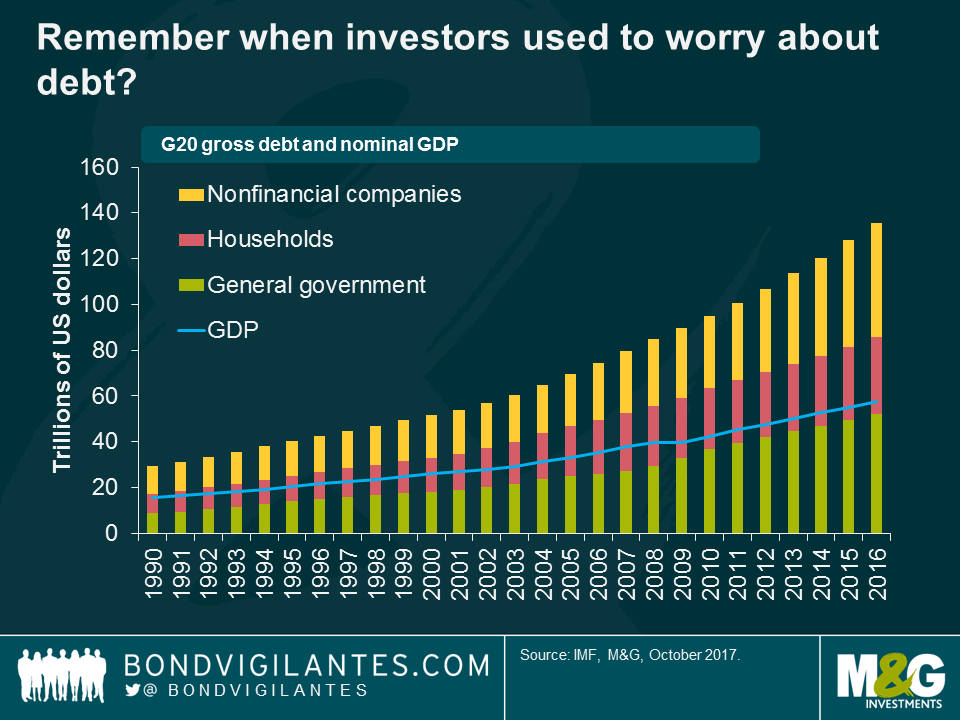
If for example 25% of the national debt has been exchanged for zero coupon perpetual securities (cash), then an 80% debt to GDP ratio effectively gets transformed into a 60% debt to GDP ratio, as 20% costs nothing to finance, never has to be repaid, and so is therefore effectively free finance.

The more of your outstanding debt you can finance at zero cost forever, the more debt you can sustain. If this free financing is undertaken responsibly it can be used as a sensible economic tool. However, if the temptation of free finance results in a misallocation of resources via the state, then it can be very harmful to the economy. This is why many economies have introduced the concept of an independent central bank to remove some of the political process from the real economy.

So far, the BoE has convinced the market that QE is a responsible policy. The use of QE has neutered the bond vigilantes, whilst the next enemy of this policy, the currency vigilantes, remain dormant.

The BoE could officially cancel the gilts or could simply exchange its existing gilts at maturity for new gilts to maintain the windfall gain of free finance. This topsy turvy world of money printing, low bond yields and free financing is a new challenge for investors.

Page 1 of 1212345...10...Last »