






anthony_doyle_100

What is the probability of a U.S. recession in the next 12 months?

Knowing how poor the central banks have been at forecasting economic indicators, and having analysed the IMF’s wild forecasts, we think that it makes sense to take consensus views with a large grain of salt. However, there is a substantial body of empirical evidence that has emerged since the 1980s that suggests that the bond market is a pretty good predictor of real economic activity.

It has been proven that the slope of the yield curve has had a consistent negative relationship with economic activity in the U.S., with a lead time of around 1-1.5 years. By analysing the difference between 10-year and 3-month Treasury rates (also known as the treasury yield-curve spread), it is possible to calculate the probability of a recession in the U.S. in the coming 12 months. The theory goes that a monetary tightening will increase short-term rates, resulting in a flat (or inverted) yield curve as the economy slows and demand for credit falls. Additionally, inflation expectations may also fall at this time.

Research has shown that the yield curve has predicted essentially every U.S. recession since 1950 with only one “false” signal, which preceded the credit crunch and slowdown in production in 1967. This is shown in the chart below. There is also evidence that the predictive relationships exist in other countries, such as Germany and the United Kingdom.

The yield curve is a good recession predictor

Having established the predictive power of the yield curve, economists naturally wanted to assess what the yield curve was telling us about the probability of recession going forward. In 1996, economists from the Federal Reserve Bank of New York estimated the likelihood of recession based on the yield-curve spread.

Helpfully, the Federal Reserve Bank of New York updates its research on a regular basis. So what probability of recession in the next 12 months is the bond market currently pricing in? The answer is 5.38% to be precise (this is probably lower than it should be due to the Fed embarking on a record amount of quantitative easing).

5.38% chance of U.S. recession in the coming 12 months

Some economists swear by the predictive power of the yield curve. Others argue the yield curve has lost some of it predictive power due to other factors that are driving the longer end of the yield curve; such as quantitative easing, currency pegs to the U.S. dollar, and regulations. However, the simple rule of thumb that the difference between ten-year and three-month Treasury rates turns negative in advance of recessions is still reliable, with negative values observed before the 1990-1991, 2001 and 2008 recessions. Perhaps Alan Greenspan’s “conundrum” of low long-term interest rates wasn’t due to what Ben Bernanke termed as a “global savings glut”. Rather, the yield curve was telling us that the chances of recession were rising, and this is reflected in the increase in the probability of recession from 4.5% in January 2006 to 38% in January 2008.

The yield curve remains a great tool for investors. Its power to predict recessions cannot be ignored, so beware if it inverts again.

This entry was posted in yields and tagged , , by . Bookmark the permalink.

Please note the content on this website is for Investment Professionals only and should be shared responsibly. No other persons should rely on the information contained within this website.

anthony_doyle_100

The chart annoying every Aussie consumer

In 2012, the Reserve Bank of Australia cut its cash rate five times and by a total of 1.25%. That is a big move in interest rates for an economy growing at 3.1%, an unemployment rate of 5.4% and inflation sitting bang-on target at 2.0%. The RBA cash rate is now equal to the 50-year low seen during the 2009 recession. So what has got the RBA so nervous?

One word: consumption. Around 54% of Australian GDP is household consumption. But the household saving rate, at 10.6%, is more than double the average of the past decade. Aussies are deleveraging. Consumption, for so long the driver of growth in the boom years, has stumbled.

And unfortunately for the RBA, the latest GDP statistics showed limited sign of investment outside the mining sector. Certainly the appreciation of the Australian Dollar – once known as the “Aussie Battler” or “Pacific Peso” – has not helped things. On a trade-weighted basis, the Australian Dollar has risen by 45% since January 2009, leading to calls from industry for the RBA to intervene in currency markets. The strong dollar is a huge headwind for the Australian manufacturing sector in an increasingly globalised world. The RBA is hoping that a reduction in interest rates will a) spur household consumption and b) have some impact on the strength of the currency.

On the currency front, the RBA rate cuts have had minimal impact. The trade weighted index rose over the course of 2012 by 1.7%. Ouch. On the consumption front, unfortunately for the RBA and the heavily indebted Aussie consumer, the banks haven’t been playing ball. The chart below highlights the spread differential between variable mortgages, variable term loans, and the standard credit card rate over the RBA’s cash rate.

The chart scaring every Aussie consumer

Despite a record low cash rate of only 3.0%, the spread between the rate charged on personal loans and credit cards is at a record highs. Banks aren’t passing on the full cuts in the official rate. In the variable home loan space, the spread has been steadily rising since October 2007. It is particularly important to have a look at the variable mortgage rate as around 80% of home loans in Australia are variable rate mortgages. Overall, the chart shows that the transmission mechanism of monetary policy in Australia is becoming increasingly muted, presenting greater challenges for the RBA.

Central banking isn’t the easiest job in the world at the best of times. Due to high rates of indebtedness and home ownership, the RBA has previously found that moving interest rates could quickly stimulate the economy if needed. The last thing that central bankers need is a further handicap on their ability to deliver their inflation targets. But that is exactly what is going on in Australia right now and the RBA should be concerned.

mike_riddell_100

Is the Federal Reserve running out of ammo, and if so, what does this mean for financial markets?

Almost every financial asset seems to have gone up – in the last year, you’d have made money if you’d bought US Treasuries, corporate bonds, gold or even Italian equities.  It’s only really emerging market currencies or EM equities that have disappointed.  The concept of portfolio diversification and uncorrelated asset classes seems to have gone out of the window, but who cares when everything’s going up, right?

The first chart illustrates this point, showing the S&P 500 (pink line, left axis) against the 30 year US Treasury yield (green line, right axis).  US Treasury yields and US equities used to be strongly correlated, but in the last year Treasury yields have collapsed while equities have soared to 2007 levels.  The time value of money concept suggests it makes sense for equities to rally if US treasury yields have collapsed, because all else being equal, the present value of a company’s dividends or free cash flow or whatever you’re looking at has increased dramatically owing to the much lower discount rate.

Still, this correlation breakdown bothers me.  If it’s correct that everything has rallied on the back of the promise of central bank liquidity, then presumably every asset class can also fall if this liquidity is no longer available.

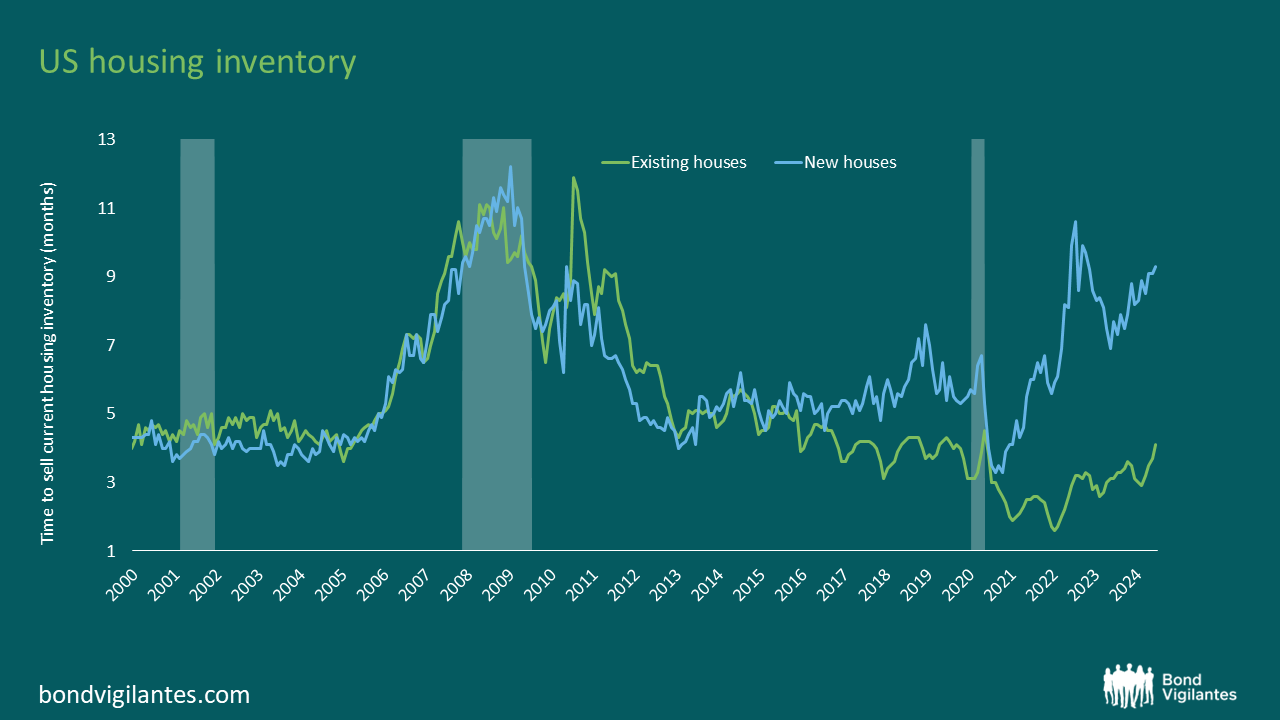
The central bank that seems to me to be closest to running out of policy options appears to be the Fed.  Sure, unemployment is falling at a painfully slow rate, but unemployment is a lagging indicator.  Probably the most important thing for the US economy is the US housing market.  The US consumer may be close to having delevered, and if the housing market rallies, consumers are fine, banks are fine, banks can start lending again and economic growth can return.  US house prices are (just) increasing again, and some of the lead indicators are unquestionably bullish.  In 2007/08 we focused a lot on measures such as the months supply of houses, which says how long the supply of houses on the market will last at current levels of demand.   In 2007/08 we showed that this measure was predicting a US recession (see here), whereas this lead indicator is now suggesting the total opposite – the months supply of new homes (for which there is a much longer history) has only looked more favourable a handful of times in the last 50 years, and is closing in on the go go years of 1997-2005.

This chart also bothers me.  The Federal Reserve’s favourite measure of market implied inflation expectations is the 5 year 5 year forward breakeven inflation rate, and inflation expectations have recently risen above 2.8%, the highest in over a year.  Admittedly part of the increase in inflation expectations has been due to Bernanke’s comments, but it’s noticeable how much higher inflation expectations are today versus where they were in summer 2010, when the Fed indicated it was getting ready for QE2.

It’s possible that we’ll see additional stimulus from the Fed over the coming months and years, and we are still very far away from a 1970s-style stagflationary environment that would likely see all asset classes really suffer.  But the ‘Bernanke put’ is becoming a lot harder to justify, and this could pose problems to both ‘safe haven’ assets as well as risky assets.

This entry was posted in inflation and tagged , by . Bookmark the permalink.

Please note the content on this website is for Investment Professionals only and should be shared responsibly. No other persons should rely on the information contained within this website.

richard_woolnough_100

Climate change – bzirc monetary policy

As investors we get used to living within certain recognised bounds. For example, it has been commonly assumed that interest rates cannot be sub-zero. There has been the odd historical quirk when we’ve seen negative rates (Switzerland in the 1970s), but that’s more for amusement than general investment consumption. However, there now appears to be the potential for a major investment climate change.

There are already plenty of bond markets now living in the sub zero ice age, such as Switzerland, Denmark, Germany, Finland and the Netherlands. In these cases, the existence of negative rates could be down to the desire to express a currency or re-denomination view (as Mike previously wrote), so may be seen as a by-product of external factors and not of domestic monetary policy. However, there is now the potential for G7 monetary policy to enter the previously unbelievable reality of official sub-zero rates.

Many G7 economies have implemented very low rates and quantitative easing for a number of years, yet still appear to be in the economic doldrums with high unemployment, low growth and limited fiscal room. It could now be time for a significant change in the investment text book as central banks experiment with rates below zero.

Theoretically, a negative interest rate sounds simple – you put £100 in the bank and you get £99 back a year later if the rate is -1%. A  rational investor would of course have the alternative of simply keeping their cash under the mattress and not suffering the negative rate, although the incentive to behave rationally would be limited by the administrative burden and security risk of holding cash.  The central bank could simply limit this activity by basically not printing enough cash. Therefore the vast majority of money would have to be held electronically and could therefore suffer a penal negative rate. Implementation of sub zero rates is possible.

From a central bank’s point of view this should be stimulative, as it would discourage saving and encourage consumption like any traditional interest rate cut. At the extreme you could create exceptionally low, zero, or even negative borrowing rates.

The challenges faced by central banks and governments are still there despite traditional and unconventional policy action. Maybe it will soon be time to use the conventional tool of cutting interest rates in an unconventional way by making them negative. The next step to be taken by the authorities might mean economies working in a below zero interest rate climate (bzirc monetary policy).

anthony_doyle_100

RBA slashes interest rates – the lucky country is getting nailed

Today the Reserve Bank of Australia (RBA) surprised markets by cutting official interest rates by 0.5% to 3.75%. Weaker inflation data out last week and a deluge of soft economic data has got the RBA rattled. We’ve discussed bubbles down under on this blog before and think that a combination of a falling terms of trade, a current account deficit, a deleveraging consumer, below target inflation, a softer labour market and a housing bubble will see the RBA retain a bias to cut interest rates further.

Dylan Grice from Societe Generale recently wrote a piece that rather nicely added to the debate:

“Australia has five of the world’s 15 most expensive cities (on a median price to median income ratio), has seen household debt levels explode in recent decades, and even has a current account deficit despite the windfall terms of trade improvement caused by the commodity bull market. This is not a robust base from which to weather a Chinese hard landing, if and when it comes”…”When you scratch the surface of the Australian ‘miracle’ you don’t just find an unmiraculous commodity super-cycle: you also find an equally unmiraculous credit super-cycle as well. A credit bubble built on a commodity market built on an even bigger Chinese credit bubble, Australia looks like leveraged leverage, a CDO squared.”

The RBA is hoping that interest rate cuts will boost the flagging economy. We are not so sure. The Australian economy has already received two interest rate cuts in November and December last year. The impact of these cuts on the real economy has been muted to say the least when we look at key consumer indicators like retail trade and consumer confidence.  The problem is the major banks have not passed on the interest rate cuts to the heavily indebted consumer. A standard variable loan in November 2011 was 7.80%. Today, the same loan will cost 7.55%. And it doesn’t look likely the banks will pass on today’s cut either (at least not all of it), as they are likely to continue to point to higher funding costs as a reason to retain higher interest rates and hence protect profits.

So what is happening down under? Here are a few key data points that have raised our eyebrows:

  • One in seven Australian taxpayers own an investment property.
  • Australian housing credit is at its weakest level in 35 years.
  • New home sales are an at 18 year low.
  • House prices are down 10% in real terms from the June 2010 peak and nominal prices have been falling for 15 months, which is the longest downturn in a decade.
  • 63% of property investors reported a taxable loss in 2009-10 according to the Australian tax office.
  • 74% of those making a loss on their investment property earned less than $80k AUD per year (the average full-time adult earns around $70k AUD per year).

The housing bubble shouldn’t be the only thing keeping the RBA up at night. At least until very recently, the Australian Dollar has held up surprisingly well in the face of falling bond yields, most likely thanks to the world’s infatuation with Australia’s debt. This doesn’t look sustainable.  Most recently, we talked about the worrying and dramatic rise in foreign ownership of the Aussie government bond market and figures recently released show that foreigners bought another A$16bn of Australian government bonds, the second biggest amount ever, eclipsed only by the previous quarter’s $20.8bn surge. Foreign ownership increased from 80.4% at the end of Q3 to a record 84% at the end of Q4 (see attached graph).

Foreign ownership of Australian government bonds is worryingly higher

But as we argued in January, if China wobbles or the Australian housing market starts to correct then the RBA will be forced to cut rates which will reduce the Australian Dollar’s appeal.  This interesting bloomberg article gives a great insight into what’s driving the flows – foreigners are piling into Australian government bonds as a carry trade and as a means to gain exposure to the currency.  If the yield pick up diminishes and/or the currency falls, then the huge number of foreign investors will start to leave, which will put further downward pressure on the currency.  Australia isn’t as bad as Ireland – the government won’t go bust as it can print its own currency, but the banking sector is obviously vulnerable.  It’s easy to see how a nasty downward spiral can quickly develop.

anthony_doyle_100

Central banks’ poor forecasting records and why the Fed may hike rates before late 2014

Central banking has evolved substantially in recent decades. Part of this evolution has involved a move towards greater transparency around a central bank’s forecasts and operations. The reason for this shift is because it is believed by many economists that by having a central bank communicate its objectives and forecasts, economic agents like consumers and businesses will make better informed decisions and allocate resources more efficiently. Theoretically, the real economy should improve.

The problem is, economic forecasting is a difficult game to be in. Many private sector economists have had a torrid time over the past five years in attempting to assess the state of the real economies of the US, Europe and the UK. If you think that central bankers have had it any easier, then you would be wrong. Time and time again, central bankers have been proven wrong with their economic forecasts.

For example, the following chart (courtesy of John Wraith at Bank of America Merrill Lynch) highlights the dismal inflation forecasting record of the Bank of England. It shows actual inflation versus the BoE’s forecasts from the quarterly inflation report. Time and time again over the past couple of years the BoE has forecast lower inflation, and time and time again it has been wrong. This is worrying if you are an inflation targeting central bank.

This poor record of forecasting is not limited to the Bank of England. The chart below shows the record of the Reserve Bank of Australia in forecasting Australia’s terms of trade. As you can see, the RBA’s forecast of a fall in the terms of trade has repeatedly been proven wrong, largely caused by the boom in China and its appetite for Australian commodities. The RBA should be right on top of developments in resources markets – and it probably is – but this has not helped the RBA in determining the future course of Australia’s terms of trade.

The charts above highlight how two central banks, the BoE and RBA, can be totally inaccurate in forecasting major economic variables. Of course, there are many more examples of central banks providing inaccurate forecasts including this amusing lowlights package of Ben Bernanke.

Of course, markets have shown that this poor forecasting record is not limited to public institutions. The forward market for interest rates has repeatedly priced in interest rate hikes and has continually been disappointed by the Bank of England’s lack of action (in fact, the BoE has done the opposite to hiking rates and pumped the economy with further QE).

Let’s turn now to the US Federal Reserve. In January 2012, the Federal Open Market Committee (FOMC) took the extraordinary position of indicating that interest rates will be at exceptionally low levels until late 2014. The markets have read this as an assurance that interest rates are on hold until that time. But I am not so sure.

From the January monetary policy release – “In particular, the Committee decided today to keep the target range for the federal funds rate at 0 to 1/4 percent and currently anticipates that economic conditions–including low rates of resource utilization and a subdued outlook for inflation over the medium run–are likely to warrant exceptionally low levels for the federal funds rate at least through late 2014”.

I have underlined the most important part of this statement. The FOMC’s forecast that interest rates will remain low or on hold until late 2014 is based on the FOMC’s forecasts of US economic conditions, in particular resource utilisation and inflation over the medium run. And as we have seen above, these forecasts are frequently plain wrong.

We won’t be surprised to see the Fed hike rates before late 2014. And that is because central banks are terrible forecasters of economic variables, just like the rest of us. If we start to see a real improvement in the fortunes of the US economy (and there is already evidence of this occurring) and inflation expectations start to rise, then the Fed will face a substantial dilemma. Will Bernanke and company hike rates in order to maintain inflation fighting credibility, or will they maintain ultra-low interest rates in order to support the real economy? Should they fail to act in an environment of higher inflation outcomes, we will have the clearest indicator yet that the financial crisis has caused central banks to have a re-think about the goals of monetary policy.

ben_lord_100

Markets start to think about inflation again

Over the last few weeks we have witnessed a meaningful bounce in inflation breakevens in the UK, Europe and the US. When breakevens are rising, it is a signal that the fixed income market is anticipating higher inflation than has been priced in. It also means that index linked bonds are outperforming conventional bonds. In the UK, the linker gilt of 2016 has outperformed the conventional gilt by 45 to 50 basis points in yield terms since the start of this year.

Inflation expectations are rising

Why have the bond markets started to price in higher levels of inflation?

Perhaps there is an element of geo-political risk affecting the oil price, which feeds into the inflation baskets in a plethora of forms? Yes, but I don’t think oil is the major culprit here, although in the US, where oil is taxed far less than in the UK or Europe, inflation is far more sensitive to changes in the oil price. See Jim’s blog here.

Perhaps rising breakevens owe to fears around money creation? In Europe, at the end of 2011 the interbank market was completely disfunctional, and we were entering a deflationary spiral. But the long term repurchase operations (LTRO) have added somewhere in the region of €1 trillion euros to banks over the last few months, the interbank market has been showing signs of being slightly less disfunctional, and the risks of deflation feel for the moment substantially reduced. In the UK, the mechanism of quantitative easing boosted the prices of conventional gilts more than index linked gilts, as the Bank of England did not purchase linkers directly. This artificially suppressed the relationship between the conventional gilt and the linker (the breakeven), at exactly the moment when money creation ought, in my opinion, to have seen higher inflation risk premia priced in. The strong performance of index linked gilts in the UK either owes to a fear that improved economic data means we are closer to the end of QE than the beginning, so the artificial source of demand for gilts is not going to be in the market for much longer (a relative call), or owes to the market’s deciding that we are not going into a disinflationary or deflationary economy, and are more likely to see on target inflation or higher.

It is worth thinking about the levels of 5 year breakevens in the chart, a relative valuation measure. In the UK the bond market is expecting inflation to average 2.8% a year for the next five years. Remember though that this is RPI inflation, which historically has averaged 0.8% more than CPI. If we assume this historical relationship holds, then this 5 year breakeven implies CPI will be bang on the Bank’s target of 2%. So on this basis the breakeven does not make inflation protection look expensive at all. Considering the 5 year breakeven in Europe, which is currently 1.6%, this is still pricing in inflation being below the 1.8% (ish) target on average for the next 5 years. With aggressive money creation (at last!), surely the risks are skewed to the upside? In fact, only the US market is pricing in inflation to be above target for the next 5 years. I think that this is the correct side of the inflation target for linkers to be valued at, and I believe there is a good chance the UK and European markets start to move towards this US dynamic.

Why? Firstly because of the ultra low interest rates and ultra accommodative monetary stance at the ECB, BoE and Fed. And also because of the large scale money creation we have seen in all three markets and have discussed briefly above. But most importantly to me is the fact that at this moment in time, the three central banks in question all have a clear and visible inflationary bias. They would rather have inflation than deflation (rightly). But now they are showing a propensity to favour above-target inflation over below-target inflation. This is tantamount to a (temporary or permanent, we do not yet know) change in the inflation targets. And this must, in my opinion, see higher inflation risk premia. How do we show this clear inflationary bias? Inflation is significantly above target in all three economies, and yet policy is not only not being tightened, the taps are still very much on!

jim_leaviss_100

Is bond market price action looking a bit like 1993-94? And the timing of fairytale 100 year bond issues.

1993 was a golden year for US Treasury investors, with 10 year yields falling from 6.7% at the start of the year to 5.3% by its end.  It felt like nothing could go wrong – and inflation had even fallen throughout the year from 3.3% to 2.7%.  Yet on 4th February 1994, the Fed hiked rates by 0.25%.  And they hiked again in March, by 0.5% in May and August, and a further 0.25% in November.  The annual inflation rate was still actually falling until May 1994, when it hit 2.3%, and on a monthly basis in January, just before the shock hike, inflation was 0%!  Yet the Fed was right – there were some price pressures in the economy and these became visible in the third quarter of 1994.  Their trigger was a significant improvement in economic growth.  At the start of 1993 the economy was growing at under 1% on an annualised rate, but this had dramatically improved to over 5% by year end.  By early 1995 though it was back below 1% after the series of aggressive rate hikes – a result that perhaps led the Fed to be much more gradualist in future expansions?

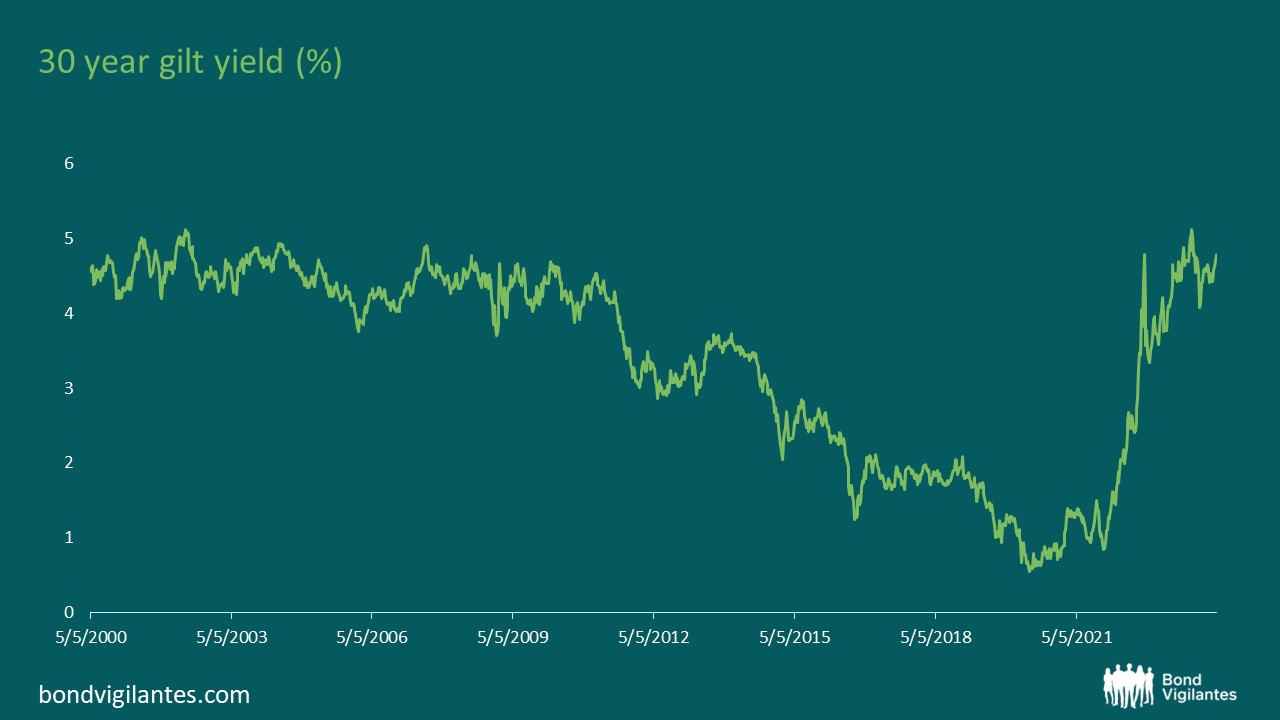
The reason we are interested in 1993-94 is that the price action in Treasuries back then looks very similar in scale and direction to what we saw in gilts and other markets in 2011.  The 10 year gilt yield fell from nearly 3.5% to below 2% in a year.  Since the start of this year yields have started to rise again, with big moves in the last 3 days.  It’s a similar pattern to 1994 but with one big difference – there’s no way that Central Banks are going to hike rates this year is there?  And that alone makes a sell off on 1994′s scale unlikely.

A couple of last points though – firstly the US Fed has said that economic conditions “are likely to warrant exceptionally low levels for the federal funds rate at least through late 2014″.  But note that this is not an explicit promise, but is totally contingent on the economic activity.  And also note that the market no longer believes that “late 2014″ is when rates will rise – the market is now pricing in a Fed rate hike in 2013, and for rates to be around 75 bps higher by the late 2014 Fed expected first hike.

And secondly, I have also marked on the chart the date when Walt Disney famously issued a 100 year $ bond, just months before the massive bear market began.  I’ve also marked George Osborne’s announcement of the potential 100 year gilt in the UK this week.  The Circle of Life?  When You Wish Upon a Star?

Does 2011-12 look a bit like 1993-94?

jim_leaviss_100

The Bank of England should cut rates rather than make state run Halifax hike mortgage rates

I had lunch last week with a Bank of England MPC member, and I asked him why the Bank didn’t cut rates below 0.5% in order to help the banking sector improve its Net Interest Margins (NIMs) and thus its capitalisation.  The MPC member replied that it was a matter of record that the Bank had discussed a rate cut in the Autumn but rejected it because of some technical reasons around the operations of the money markets (which nobody seems able to fully explain) and because the feed through into the banks’ funding costs would likely be limited.

I disagree that there would be no benefit in a Bank rate cut, and the news this weekend that Halifax is raising its mortgage rate from 3.5% to 3.99% for 850,000 Standard Variable Rate (SVR) mortgage borrowers will help show why.  Halifax (HBOS) needs to improve its margins and become profitable before it will be able to increase its lending to the UK economy and slow its delevering.  The method it (the state?) has chosen to improve its margins is to raise the interest burden on UK consumers (by 14% to those on the SVR).  This is a zero sum game to the UK economy (consumers lose by the amount that the banks gain – there might even be a negative multiplier effect as the banks use their gain to delever whilst the consumer stops spending to the extent of their loss?), whereas if the Bank of England cuts rates (to near zero) many of the funding costs that directly impact HBOS, including LIBOR and 5 year interest rate swap rates would also fall.  HBOS wouldn’t need to pass on these rate cuts to customers, but the mortgage borrowers are not worse off, and the banks have improved their margins.  So the Bank of England should cut rates later this week – the impact will of course be relatively small as we reach the “zero bound”, but it is probably more certain in its effectiveness than a theoretically equivalent amount of Quantitative Easing.

Finally, the papers I read this weekend talking about the Halifax SVR rate increase said that the reason for the hike was due to increased funding costs in the wholesale markets.  But is that true?  I’ve put 4 charts together here.  They show that 3 month LIBOR rates (a measure of short term money market costs) have fallen year to date (albeit marginally), that 5 year swap rates (a measure of fixed rate mortgage funding costs) remain around record lows, and that senior CDS spreads for both European banks in general and HBOS specifically are both much lower than their 2011 Q4 highs.  So if anything, since the ECB announced its 3 year LTRO facilities, the both cost of funding and the availability of liquidity for the banking sector have improved – and mortgage rates in an ideal world should be falling.

Bank funding costs have fallen since LTRO

stefan_isaacs_100

The ECB’s mandate says raise rates, but is the ECB’s mandate correct?

The European Central Bank firmly laid its cards on the table at last Thursday’s press conference. Trichet et al are in no mood to risk potential second-round effects of rising wages. According to JP Morgan the phrase ‘strong vigilance,’ uttered by Trichet during his prepared remarks, was used one month prior to all policy moves during the last tightening cycle. Not surprising then that Bunds sold off and the Euro climbed. A 25 basis point hike in April to 1.25% is now all but a done deal.

Critics have weighed in with chants of an impending policy error on the ECB’s part. Whilst accepting commodity price inflation is clearly on the rise, there are limited signs of second round effects. As Jim wrote last month, recent union negotiated wage increases in Germany, Europe’s strongest economy, have proved fairly muted.

It’s hard to argue with claims that rate hikes will merely heap pain on an already embattled periphery. Coupled with structurally high unemployment, fiscal austerity and a seriously damaged banking system, the prospects don’t bode well for growth .

We know that the ECB’s primary and overarching aim is to ensure price stability. As the ECB notes “We… have as our primary objective the maintenance of price stability for the common good.” In fact, the ECB would argue that price stability is a prerequisite for long run sustainable growth and low unemployment. However, as we’ve argued before, if it comes down to a choice between protecting its inflation credentials and growth the ECB will side with the former. Is it right to damage Europe’s growth prospects to tame an inflation rate that currently stands at 2.3%, largely due to factors outside the ECB’s control?

Some argue that the ECB should not be so nervous about losing its inflation fighting credibility. As MPC Member Adam Posen points out in a recent speech, the Deutsche Bundesbank did not lose its anti-inflationary credibility post the oil shock of the late 1970s, despite inflation running above its 2% target for over six years. Posen claims that despite regularly overshooting both its inflation and money supply target, the Bundesbank was able to keep inflation expectations anchored through the “transparency and flexibility of its monetary framework.”

Perhaps the ECB should give serious thought as to whether it could also engineer a similar scenario. The consequences of prematurely embarking on a tightening cycle could prove disastrous for parts of the European Community and beyond; even if they’re only doing their job.

Page 1 of 212